
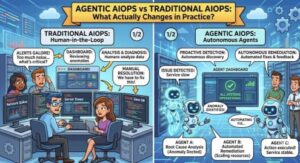
Artificial Intelligence for IT Operations (AIOps) has transformed how organizations monitor, manage, and optimize modern IT infrastructure. By combining machine learning, analytics, and automation, Traditional AIOps has helped IT teams reduce alert fatigue, identify anomalies faster, and improve operational efficiency.
However, as enterprise environments become increasingly distributed across cloud platforms, Kubernetes clusters, edge devices, and hybrid infrastructures, Traditional AIOps is beginning to show its limitations. Today’s IT teams need systems that don’t just detect problems they need systems that can understand context, make informed decisions, execute remediation, and continuously learn from outcomes.
This is where Agentic AIOps enters the picture.
Unlike Traditional AIOps, Agentic AIOps introduces autonomous AI agents capable of reasoning, planning, collaborating, and taking action with minimal human intervention. Rather than acting as an intelligent monitoring assistant, Agentic AIOps behaves more like a highly skilled operations engineer working alongside your IT team.
So what actually changes in practice? Let’s explore the real-world differences.
Understanding Traditional AIOps
Traditional AIOps platforms focus primarily on three core capabilities:
- Collecting logs, metrics, traces, and events
- Detecting anomalies using machine learning
- Automating predefined workflows
Most solutions work by ingesting massive amounts of operational data, correlating events, identifying abnormal behavior, and notifying engineers.
For example, if CPU usage spikes across multiple servers, the platform may correlate alerts and suggest that a database server is causing downstream performance issues.
However, the final decision still rests with human operators. Engineers investigate, validate the recommendation, determine the root cause, and execute remediation steps.
Traditional AIOps excels at improving visibility but remains heavily dependent on human expertise.
What is Agentic AIOps?
Agentic AIOps represents the next evolution of intelligent IT operations.
Instead of simply analyzing data, autonomous AI agents actively work toward operational goals.
These agents can:
- Understand business objectives
- Gather relevant operational context
- Reason through multiple possible causes
- Plan corrective actions
- Execute approved workflows
- Validate outcomes
- Learn from every interaction
Rather than responding to isolated alerts, they continuously monitor the health of the environment and proactively solve problems before users even notice them.
Think of Traditional AIOps as a GPS giving directions.
Agentic AIOps is more like an autonomous driver that navigates traffic, reroutes around accidents, refuels when necessary, and safely reaches the destination without constant instructions.
The Biggest Practical Differences
1. From Alerting to Goal-Oriented Operations
Traditional AIOps answers questions like:
- What happened?
- Where is the anomaly?
- Which alerts are related?
Agentic AIOps answers a different question:
“How do I restore service availability as quickly and safely as possible?”
This shift changes everything.
Instead of generating another alert, AI agents initiate investigations, collect evidence, identify dependencies, and recommend or execute remediation.
The focus moves from event management to outcome management.
2. Context Becomes the Primary Decision Maker
Traditional systems often rely heavily on historical data and statistical correlations.
Agentic systems combine:
- Infrastructure topology
- Service dependencies
- Configuration changes
- Incident history
- Change management records
- Knowledge bases
- Business priorities
- Security policies
This richer understanding enables much better decisions.
For instance, restarting a production database during peak business hours may technically resolve an issue—but an Agentic AI recognizes the business impact and explores safer alternatives first.
3. Autonomous Investigation
One of the biggest bottlenecks during incident response is collecting information.
Engineers typically spend valuable time checking dashboards, querying logs, reviewing deployment history, and comparing system metrics.
Agentic AIOps automates this entire investigation process.
An AI agent can:
- Review recent deployments
- Compare configuration changes
- Analyze logs
- Inspect Kubernetes events
- Check cloud infrastructure health
- Identify upstream dependencies
By the time an engineer joins the incident, much of the diagnostic work has already been completed.
4. Dynamic Decision Making
Traditional automation follows predefined rules.
For example:
“If CPU > 90%, restart service.”
Agentic AIOps reasons through multiple options.
Instead of blindly restarting a service, it may determine that:
- Increased traffic is expected.
- Auto-scaling is delayed.
- A dependency is unavailable.
- Rolling back a deployment is safer.
- Increasing replicas solves the issue without downtime.
This flexibility dramatically improves operational resilience.
5. Continuous Learning
Traditional AIOps models improve through retraining.
Agentic systems learn from every completed workflow.
Successful remediations become reusable strategies.
Failed actions become lessons that improve future decision-making.
Over time, the AI develops organizational knowledge similar to experienced operations engineers.
A Real-World Incident Comparison
Imagine an e-commerce website experiences a sudden increase in checkout failures.
Traditional AIOps Workflow
- Detect increased error rates.
- Correlate alerts.
- Notify on-call engineers.
- Engineers investigate.
- Root cause identified.
- Engineers execute fix.
- Service restored.
Average response depends heavily on engineer availability.
Agentic AIOps Workflow
- Detect checkout failures.
- Identify affected microservices.
- Compare recent deployments.
- Analyze logs.
- Discover faulty configuration.
- Validate rollback safety.
- Execute rollback automatically.
- Monitor recovery.
- Notify engineers with complete incident report.
Instead of simply informing engineers about a problem, the AI actively resolves it.
Benefits Organizations Experience
Organizations adopting Agentic AIOps often report improvements in several operational areas:
- Faster incident response
- Lower Mean Time to Resolution (MTTR)
- Reduced alert fatigue
- Higher service availability
- Improved operational consistency
- Better knowledge retention
- Increased engineering productivity
- More proactive operations
Engineers spend less time performing repetitive investigations and more time improving architecture and reliability.
Is Human Oversight Still Necessary?
Absolutely.
Agentic AIOps is not about replacing operations teams.
It augments them.
Critical production environments still require governance, approval workflows, compliance controls, and human oversight.
Many organizations begin with a “human-in-the-loop” approach, where AI agents recommend actions but require engineer approval before execution.
As confidence grows, automation can gradually expand to low-risk scenarios.
This balanced approach builds trust while maintaining operational safety.
Challenges to Consider
Despite its promise, Agentic AIOps introduces new considerations.
Organizations must ensure:
- Reliable access to operational data
- High-quality documentation
- Well-defined governance policies
- Secure permissions for AI agents
- Auditability of autonomous actions
- Explainable decision-making
Without these foundations, autonomous systems may struggle to make reliable decisions.
Building trust is just as important as building intelligence.
Which Approach Is Right for Your Organization?
Traditional AIOps remains an excellent choice for organizations beginning their observability and automation journey.
It delivers measurable improvements in monitoring, event correlation, and operational efficiency.
However, enterprises managing highly dynamic cloud-native environments increasingly require systems capable of autonomous reasoning and action.
Agentic AIOps addresses this need by shifting from passive analytics to active operational execution.
Rather than simply helping engineers find problems, it helps solve them.

The difference between Traditional AIOps and Agentic AIOps isn’t merely about adding more artificial intelligence. It’s about redefining the role AI plays in IT operations.
Traditional AIOps acts as an intelligent assistant that surfaces insights and recommends actions. Agentic AIOps functions as an autonomous collaborator that understands objectives, reasons through complex situations, executes approved tasks, and continuously improves over time.
As digital infrastructure grows more complex, organizations can no longer rely solely on dashboards, alerts, and manual troubleshooting. The future belongs to intelligent systems capable of managing operational complexity at machine speed while keeping humans in control of strategic decisions.
For businesses seeking faster incident resolution, greater resilience, and scalable automation, Agentic AIOps represents the next major step in the evolution of IT operations. The question is no longer whether AI should assist operations but how much responsibility organizations are ready to delegate to autonomous agents.
Extra posts:
 AIOps Bringing Intelligence to IT Operations
  AgentOps: The Missing Layer Between DevOps and AIOps
  Designing and Creating Agentic AI in Azure
  How Agentic AI Works and How to Build It in Azure
  Reference Architecture for Agentic AI in Enterprise IT
 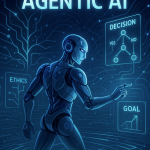 Agentic AI The Next Evolution Beyond Generative AI for Solution Architects