
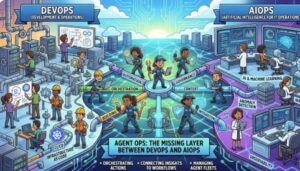
In the last decade, the way we build and operate software has transformed dramatically. DevOps broke down the walls between development and operations, enabling faster delivery, continuous integration, and scalable infrastructure. Then came AIOps, promising to harness artificial intelligence to monitor, analyze, and automate IT operations at scale.
But somewhere between these two powerful paradigms, a critical gap has emerged one that becomes more obvious as organizations increasingly adopt AI agents, autonomous workflows, and large language models (LLMs). That missing layer is AgentOps.
What Is AgentOps?
AgentOps refers to the operational discipline focused on managing, monitoring, evaluating, and optimizing AI agents in production environments. These agents can include chatbots, copilots, autonomous systems, or multi-agent workflows powered by machine learning models.
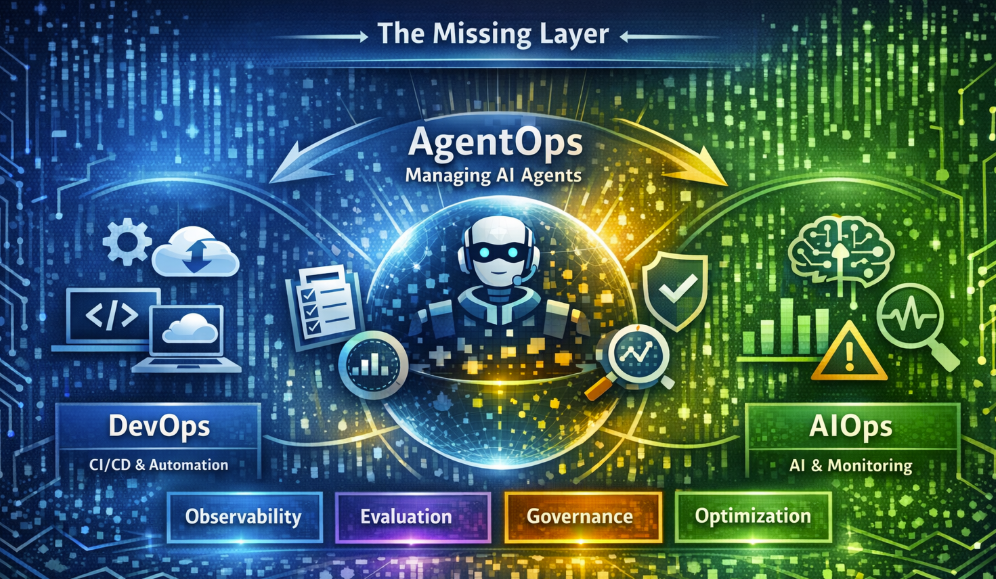
While DevOps ensures that applications are deployed reliably and AIOps helps analyze system-level data using AI, AgentOps zooms in on the behavior, performance, and governance of intelligent agents themselves.
Think of it this way:
- DevOps → Ships and maintains applications
- AIOps → Uses AI to optimize infrastructure and operations
- AgentOps → Ensures AI agents behave correctly, safely, and efficiently
Why AgentOps Is Becoming Essential
As organizations move from simple automation to intelligent autonomy, AI agents are no longer just tools they’re decision-makers. They generate content, interact with users, trigger workflows, and even collaborate with other agents.
This shift introduces new challenges that neither DevOps nor AIOps fully addresses:
1. Unpredictable Behavior
Traditional software behaves deterministically. AI agents do not. The same input can produce different outputs depending on context, training data, or model updates.
AgentOps introduces observability into this uncertainty tracking how agents make decisions, not just what they output.
2. Evaluation Complexity
How do you measure the success of an AI agent? It’s not just uptime or latency anymore. You need to evaluate:
- Accuracy
- Relevance
- Safety
- User satisfaction
AgentOps frameworks provide structured evaluation pipelines, including human-in-the-loop feedback and automated scoring systems.
3. Continuous Learning and Drift
AI agents evolve over time. Models degrade, user behavior changes, and prompts need refinement.
AgentOps enables continuous monitoring and retraining cycles, ensuring agents stay aligned with business goals.
4. Governance and Compliance
AI systems introduce risks bias, hallucinations, data leakage, and regulatory concerns.
AgentOps ensures:
- Traceability of decisions
- Audit logs for agent actions
- Guardrails and policy enforcement
Core Components of AgentOps
To understand how AgentOps works in practice, let’s break it down into its core pillars.
1. Observability for AI Agents
Unlike traditional logs and metrics, AgentOps observability includes:
- Prompt tracking
- Response tracing
- Decision pathways
- Token usage and cost monitoring
This gives teams visibility into how agents think and respond in real-world scenarios.
2. Evaluation and Testing
AgentOps introduces new testing paradigms:
- Prompt testing
- Scenario-based simulations
- Benchmark datasets
- Red-teaming for safety vulnerabilities
Testing is no longer just pre-deployment—it’s continuous.
3. Versioning and Experimentation
Agents evolve through:
- Prompt updates
- Model upgrades
- Tool integrations
AgentOps provides version control for all these elements, allowing safe experimentation and rollback when needed.
4. Feedback Loops
User feedback becomes a first-class signal. AgentOps systems collect:
- Explicit ratings
- Implicit behavior signals
- Error reports
These inputs are used to refine prompts, retrain models, or adjust workflows.
5. Cost and Performance Optimization
Running AI agents especially LLMs can be expensive. AgentOps helps optimize:
- Token usage
- Model selection
- Response latency
This ensures scalability without runaway costs.
How AgentOps Bridges DevOps and AIOps
AgentOps doesn’t replace DevOps or AIOps it complements them.
- From DevOps, it inherits automation, CI/CD pipelines, and infrastructure reliability.
- From AIOps, it leverages data-driven insights and intelligent monitoring.
But AgentOps adds a new dimension: behavioral intelligence management.
For example:
- DevOps ensures your chatbot is deployed
- AIOps ensures the system hosting it runs smoothly
- AgentOps ensures the chatbot gives correct, safe, and helpful answers
Without AgentOps, organizations risk deploying powerful AI systems with little control over their real-world behavior.
Real-World Use Cases
Customer Support Agents
Companies deploying AI support agents need to ensure:
- Accurate responses
- Escalation when needed
- Consistent tone and branding
AgentOps helps track conversations, evaluate quality, and improve performance over time.
Autonomous Workflows
In industries like finance or logistics, AI agents can execute multi-step workflows. AgentOps ensures:
- Correct sequencing of tasks
- Error handling
- Compliance with business rules
Developer Copilots
AI coding assistants must produce reliable and secure code. AgentOps introduces:
- Code quality evaluation
- Security scanning
- Feedback-based improvements
Challenges in Implementing AgentOps
Despite its promise, AgentOps is still an emerging discipline. Organizations face several hurdles:
Tooling Maturity
The ecosystem is still evolving. Unlike DevOps, which has mature tools, AgentOps platforms are just beginning to standardize.
Skill Gaps
Teams need a blend of:
- ML expertise
- Software engineering
- Product thinking
This hybrid skill set is still rare.
Cultural Shift
AgentOps requires teams to think differently:
- From deterministic systems → probabilistic systems
- From static deployments → continuous adaptation
This mindset shift can take time.
The Future of AgentOps
As AI agents become more autonomous and deeply integrated into business processes, AgentOps will become a foundational layer in the tech stack.
We can expect:
- Standardized AgentOps frameworks
- Better observability tools for LLMs
- Automated evaluation pipelines
- Stronger governance and compliance systems
Eventually, AgentOps may become as essential as DevOps is today.
AgentOps is not just another buzzword—it’s a necessary evolution in how we manage intelligent systems. As organizations race to adopt AI agents, those who invest in AgentOps will have a clear advantage: better performance, lower risk, and greater trust in their AI systems.
In a world where software is no longer just written but learns and adapts, AgentOps provides the discipline needed to keep everything under control.
Extra posts:
 AIOps Bringing Intelligence to IT Operations
  DevOps Meets Microsoft AI Accelerating Innovation in the Cloud Era
  How AI is Transforming DevOps Smarter, Faster, and More Reliable Software Delivery
  Top AI & CLI Prompts DevOps Can Use to Manage Azure Efficiently
  The Daily Stand-Up Agent A Custom Copilot for Summarizing Jira & Azure DevOps Progress
  Unveiling Microsoft Fabric AI The Future of Data Intelligence