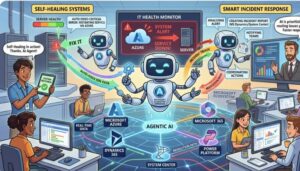
Modern IT infrastructures are evolving rapidly. Organizations now run workloads across hybrid cloud environments, microservices architectures, Kubernetes clusters, and distributed applications. Managing this complexity with traditional monitoring tools is becoming increasingly difficult.
IT operations teams often deal with:
- Thousands of daily alerts
- Complex dependency chains
- Long troubleshooting cycles
- Increasing Mean Time to Resolution (MTTR)
This is where Agentic AI is transforming the landscape of IT operations.
Agentic AI refers to AI systems capable of autonomous decision-making, reasoning, and action execution. Instead of simply detecting problems, these systems can analyze incidents, determine root causes, and execute remediation automatically.
Within the Microsoft ecosystem, technologies such as Azure Monitor, Azure AI, Microsoft Copilot, Azure Automation, and Azure Arc are enabling organizations to implement self-healing systems and intelligent incident response.
From a solution architect perspective, adopting Agentic AI with Microsoft platforms allows enterprises to build resilient, intelligent, and autonomous IT environments.
Understanding Agentic AI in Microsoft IT Operations
Agentic AI expands beyond traditional AIOps by combining:
- Machine learning models
- autonomous AI agents
- cloud observability platforms
- orchestration systems
- large language models (LLMs)
Microsoft is heavily investing in AI-driven IT operations, particularly through:
- Microsoft Copilot for Azure
- Azure AI Services
- Azure Monitor
- Azure Automation
- Azure DevOps
- Microsoft Sentinel
These technologies enable AI agents to observe system behavior, reason about incidents, and take corrective actions automatically.
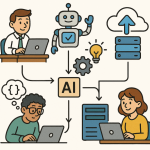
The Agentic AI operational loop typically follows five steps:
- Observe – Collect telemetry across infrastructure and applications.
- Detect – Identify anomalies using AI-driven analytics.
- Analyze – Correlate signals and determine root causes.
- Act – Trigger automated remediation workflows.
- Learn – Continuously improve incident response models.
This creates autonomous IT operations powered by AI.
Self-Healing Systems with Microsoft Azure
Self-healing systems are infrastructures capable of detecting failures and resolving them without manual intervention.
In the Microsoft cloud ecosystem, this capability is built using several services.
Azure Monitor for Intelligent Observability
Azure Monitor provides centralized telemetry collection across cloud and hybrid environments.
It collects:
- application logs
- infrastructure metrics
- distributed traces
- performance signals
Using AI-based anomaly detection, Azure Monitor can automatically detect unusual patterns in system behavior.
For example:
- sudden spikes in CPU utilization
- abnormal latency in APIs
- database performance degradation
These anomalies can trigger automated remediation workflows.
Azure Automation for Remediation Workflows
Azure Automation allows organizations to create automated runbooks that respond to incidents.
When combined with Agentic AI systems, remediation workflows can include:
- restarting failed virtual machines
- clearing application caches
- scaling Kubernetes nodes
- restarting microservices
- patching misconfigured resources
This automation dramatically reduces downtime and operational overhead.
Azure Kubernetes Service (AKS) Self-Healing
Containerized workloads often require rapid recovery from failures.
With Azure Kubernetes Service, self-healing capabilities include:
- automatic pod restarts
- container rescheduling
- node replacement
- auto-scaling clusters
Agentic AI layers can analyze cluster metrics and proactively adjust resources before incidents impact users.
Smart Incident Response Using Microsoft Copilot
One of the most powerful innovations in Microsoft’s ecosystem is Copilot-powered IT operations.
Microsoft Copilot integrates large language models with operational data to provide intelligent incident response capabilities.
AI-Assisted Troubleshooting
Copilot can analyze:
- system logs
- monitoring alerts
- service dependencies
- historical incidents
Based on this data, it can suggest probable root causes and remediation steps.
For example:
An engineer might ask:
“Why is the checkout service failing?”
Copilot can respond with insights like:
- recent deployment changes
- increased database latency
- resource exhaustion in a specific container
This dramatically accelerates troubleshooting.
Automated Incident Triage
Agentic AI systems powered by Microsoft tools can automatically:
- group related alerts
- determine affected services
- assess business impact
- prioritize critical incidents
This reduces alert fatigue, a major challenge for IT operations teams.
Integration with IT Service Management (ITSM)
Microsoft ecosystems integrate seamlessly with ITSM platforms such as:
- ServiceNow
- Jira Service Management
- Microsoft Dynamics
AI agents can automatically:
- generate incident tickets
- update incident timelines
- attach diagnostic insights
- notify engineers through collaboration tools
This creates a fully automated incident response workflow.
Security Incident Response with AI
Cybersecurity is another area where Agentic AI is delivering major improvements.
Using Microsoft Sentinel and Defender, AI agents can automatically detect and respond to threats.
Capabilities include:
- anomaly detection in user behavior
- automated threat investigation
- isolating compromised machines
- blocking suspicious IP traffic
Security teams benefit from faster threat containment and improved incident visibility.
rchitecture of Agentic AI in Microsoft Environments
From a solution architect perspective, implementing Agentic AI typically involves several architectural layers.
Observability Layer
Telemetry is collected using:
- Azure Monitor
- Log Analytics
- Application Insights
- OpenTelemetry integrations
This creates a centralized data lake for operational insights.
AI Intelligence Layer
This layer includes:
- Azure Machine Learning models
- AI anomaly detection services
- large language models for reasoning
These components analyze operational data and detect potential incidents.
Agent Orchestration Layer
Autonomous AI agents coordinate system responses.
Agents interact with:
- Azure Resource Manager APIs
- Kubernetes APIs
- CI/CD pipelines
- ITSM platforms
They decide the best remediation strategy.
Automation and Action Layer
Remediation actions are executed using:
- Azure Automation runbooks
- Logic Apps workflows
- Infrastructure-as-Code scripts
- DevOps pipelines
The system records outcomes to improve future decision-making.
Real-World Use Cases
Cloud Infrastructure Optimization
Agentic AI can continuously optimize cloud workloads by:
- reallocating compute resources
- detecting underutilized infrastructure
- recommending cost optimizations
DevOps Pipeline Monitoring
AI agents monitor CI/CD pipelines and automatically:
- detect failed deployments
- roll back unstable releases
- notify engineering teams
Predictive Incident Prevention
Using predictive analytics, systems can identify risks before outages occur.
Examples include:
- disk capacity exhaustion
- memory leaks
- unusual traffic spikes
This shifts IT operations from reactive to proactive management.
Benefits of Agentic AI with Microsoft Technologies
Organizations implementing Agentic AI within the Microsoft ecosystem gain several advantages.
Reduced MTTR
Automated root cause analysis and remediation significantly reduce downtime.
Improved System Reliability
Self-healing architectures prevent cascading failures.
Lower Operational Costs
Automation reduces manual workload for IT operations teams.
Better Engineer Productivity
Engineers spend less time troubleshooting and more time designing scalable systems.
Challenges and Best Practices
While Agentic AI offers significant benefits, organizations must address several considerations.
Data Quality and Observability
AI models rely on accurate telemetry data. Strong observability practices are essential.
Governance and Control
Autonomous remediation should include safeguards such as:
- approval workflows
- rollback capabilities
- policy-based automation
Gradual Adoption
Enterprises should start with AI-assisted operations before moving toward full autonomy.
The Future of Autonomous IT with Microsoft AI
Microsoft is rapidly advancing AI-driven cloud operations.
Future developments may include:
- fully autonomous cloud environments
- AI-driven infrastructure optimization
- predictive incident elimination
- intelligent DevOps pipelines
As these technologies mature, organizations will move closer to self-managing digital infrastructure.
Agentic AI is redefining IT operations by enabling self-healing systems and intelligent incident response.
Within the Microsoft ecosystem, platforms such as Azure Monitor, Copilot, Azure Automation, and Microsoft Sentinel provide the building blocks for autonomous IT operations.
For solution architects, integrating these technologies into modern cloud architectures is essential to building resilient, scalable, and intelligent systems.
The future of IT is not only automated — it is autonomous, adaptive, and AI-driven.
Organizations that embrace Agentic AI with Microsoft technologies will gain a competitive advantage in reliability, operational efficiency, and digital transformation.
Extra posts:
 Microsoft Copilot and the AI-First Enterprise A Strategic Perspective
  MLOps Architectures Building Scalable AI Systems
  Software Architecture Frameworks and Artificial Intelligence Building Smarter Systems
  No-Code AI How Non-Developers Can Build Smart Chatbots with Copilot Studio
  Designing and Creating Agentic AI in Azure
  How Agentic AI Works and How to Build It in Azure