
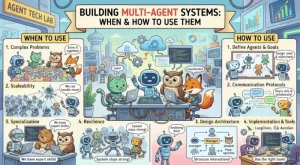
A single AI agent can summarize documents, answer questions, write code, and call external tools. But what happens when a task requires researching multiple sources, analyzing the results, validating assumptions, and producing a reliable deliverable? At some point, asking one agent to handle everything becomes difficult to manage.
That is where multi-agent systems become useful.
A multi-agent system distributes work across multiple AI agents, each with a defined responsibility, specialized tools, or a distinct role. Instead of relying on one agent to execute every step, you create a coordinated workflow in which agents collaborate, exchange information, and contribute to a shared outcome.
However, adding more agents does not automatically improve performance. It can introduce higher costs, longer execution times, conflicting decisions, and additional failure points. The real engineering challenge is understanding when multiple agents provide measurable value and how to build an architecture that remains predictable, secure, and maintainable.
What Is a Multi-Agent System?
A multi-agent system is an application in which two or more agents interact to accomplish a task that can benefit from coordinated responsibilities.
An AI agent typically combines a language model, instructions, tools, and some mechanism for maintaining task context. Depending on the implementation, it may also use memory, structured state, retrieval systems, or access to external services.
In a multi-agent architecture, these components work together under an orchestration strategy.
For example, an enterprise research workflow might include:
- Research agent: Collects information from approved sources.
- Analysis agent: Identifies patterns, evaluates evidence, and develops findings.
- Verification agent: Checks factual claims, calculations, and source quality.
- Reporting agent: Produces a structured report based on the validated results.
- Orchestrator: Assigns tasks, manages dependencies, handles failures, and determines when the workflow is complete.
Each agent has a clear scope. The orchestrator controls how work moves between them.
This distinction matters: a collection of independent chatbots is not necessarily an effective multi-agent system. A useful system needs defined responsibilities, explicit communication rules, and a reliable way to determine whether the overall objective has been achieved.
When Should You Use a Multi-Agent Architecture?
The strongest reason to adopt multiple agents is that a task naturally divides into distinct activities that require different tools, context, or evaluation criteria.
1. The workflow contains independent subtasks
Suppose you are building a competitive intelligence platform. One agent can examine competitor pricing, another can analyze product positioning, and a third can review customer feedback.
Because these activities can happen independently, the system can execute them in parallel and combine the findings afterward.
Parallel execution may reduce elapsed time, although the benefit depends on model latency, API limits, and the cost of coordinating results.
2. Different tasks require different expertise
A coding assistant might need to generate an implementation, inspect its security implications, run tests, and explain the changes.
Separate agents can specialize in code generation, security review, and test analysis. Each can use different instructions, tools, and output requirements.
Specialization is most useful when responsibilities are genuinely different—not simply when the same prompt is divided among several agents.
3. The workflow requires independent verification
A single agent may overlook errors in its own output. A separate reviewer can challenge assumptions, check evidence, and flag inconsistencies.
For instance, a financial reporting workflow might use one agent to extract figures, another to reconcile totals, and a validation stage to compare the results against authoritative records.
Independent verification is not a guarantee of correctness. Agents can share the same underlying model limitations or rely on the same incorrect source. High-stakes decisions still require appropriate deterministic checks and human oversight.
When a Single Agent Is the Better Choice
Use a single agent when the task is straightforward, sequential, and easy to evaluate. Simple document summarization, routine classification, or answering questions from a small knowledge base may not justify multi-agent coordination.
A practical rule is to start with the simplest architecture that meets your quality, latency, and reliability requirements. Introduce additional agents only when testing demonstrates a meaningful improvement.
How to Design a Multi-Agent System
A reliable implementation starts with workflow design, not with the number of agents.
Step 1: Define the task and success criteria
Describe the intended outcome in measurable terms.
For a document analysis system, success criteria might include:
- Every important claim must have a supporting source.
- Required fields must appear in the final output.
- Numerical calculations must pass deterministic validation.
- The workflow must finish within a defined latency and cost budget.
These criteria help you evaluate whether multiple agents are actually improving the system.
Without measurable objectives, it is easy to mistake longer reasoning chains and more model calls for better results.
Step 2: Assign clear agent responsibilities
Give each agent a narrowly defined job, an appropriate set of tools, and a structured output format.
For example, a research agent might return source URLs, extracted claims, publication dates, and confidence notes. An analysis agent can consume that information without repeating the entire research process.
Use structured outputs, such as JSON schemas, where practical. Validate every output before passing it to another component.
Avoid vague instructions such as “analyze everything and help the other agents.” Overlapping responsibilities make it harder to identify errors and control execution.
Step 3: Choose an orchestration pattern
The orchestration model determines how agents collaborate. Three common patterns cover many practical use cases.
Sequential workflow: Agents execute in a defined order. Each stage consumes the previous stage’s output. This works well for research, drafting, review, and final reporting.
Parallel workflow: Independent agents perform separate subtasks concurrently. A coordinator aggregates their results. This is useful for multi-source research, document processing, and independent evaluations.
Coordinator-and-specialists workflow: A central agent determines which specialist to invoke, routes requests, and combines the results. This suits dynamic tasks where the next step depends on information discovered during execution.
You can combine these patterns. For example, a coordinator might launch parallel research agents, send their results to a sequential verification stage, and then invoke a reporting agent.
The key is to make dependencies explicit. Do not allow agents to wait indefinitely for one another or repeatedly delegate the same work.
Step 4: Define communication and shared state
Agents need a controlled way to exchange information. That may involve direct messages, orchestrator-managed task objects, a shared database, or a workflow state store.
For most production applications, structured task messages are easier to debug than unrestricted conversational exchanges.
A task message could contain:
- Task identifier and parent workflow identifier
- Assigned agent and objective
- Relevant context and source references
- Expected output schema
- Deadline or execution budget
- Status, errors, and completion metadata
Keep shared state as small as possible. Passing an entire conversation history to every agent increases token consumption and can introduce irrelevant or contradictory context.
Prefer passing the information needed for the next task, along with references to supporting evidence.
Step 5: Add guardrails and failure handling
Production systems must account for agents that fail, return malformed data, exceed time limits, or produce conflicting recommendations.
Implement timeouts, bounded retries, input and output validation, and explicit failure states. Use idempotency controls for operations that might be retried, particularly when agents can modify external systems.
Also enforce permissions at the tool level. A research agent may need read-only access, while an execution agent may require narrowly scoped write permissions and human approval.
Never assume that an agent will follow its instructions perfectly. Treat retrieved documents, external webpages, and tool outputs as potentially untrusted input.
Tools and Frameworks for Building Multi-Agent Systems
Several frameworks can help developers implement these architectures, but the best choice depends on the workflow’s complexity and operational requirements.
- LangGraph: Useful for stateful workflows with explicit control flow, branching, checkpoints, and human-in-the-loop steps.
- Microsoft Agent Framework: Designed for building agent-based applications and orchestrating interactions between agents and tools.
- AutoGen: An established framework for experimenting with multi-agent conversations and coordinated task execution; evaluate its current maintenance status and migration guidance before selecting it for a new production system.
- OpenAI Agents SDK: Supports agent instructions, tool use, handoffs, and tracing for applications built around coordinated agent workflows.
You do not always need a specialized framework. A conventional application using a queue, a workflow engine, typed data structures, and model API calls can be easier to operate when the workflow is predictable.
Evaluate frameworks against practical criteria: observability, state management, integration with existing infrastructure, failure recovery, deployment complexity, and the ability to enforce your security requirements.
Common Challenges and How to Address Them
Multi-agent systems introduce operational complexity that should be addressed early.
Higher token and infrastructure costs: Every additional agent may require more model calls and context. Reduce redundant work, limit message size, and use smaller or less expensive models for tasks that do not require advanced reasoning.
Inconsistent outputs: Agents may disagree or produce incompatible data. Define output contracts, validate schemas, and establish a deterministic resolution strategy instead of asking agents to debate indefinitely.
Unpredictable latency: Parallel execution can help, but the overall workflow may still depend on its slowest agent. Set deadlines, cancel unnecessary tasks, and avoid excessive delegation.
Difficult debugging: A final incorrect answer may originate from a bad retrieval result, an agent’s reasoning, a tool failure, or an aggregation error. Record task identifiers, model calls, tool inputs and outputs, timing, and validation results while redacting secrets and sensitive information.
Security and access control: Agents can be manipulated by malicious content or misuse available tools. Apply least-privilege permissions, validate external input, isolate sensitive operations, and require approval for consequential actions.
Measuring Whether Your Multi-Agent System Works
Do not evaluate the architecture solely by whether it produces a convincing demonstration.
Build a representative test dataset and compare the multi-agent implementation against a simpler baseline. Measure task success rate, factual accuracy, tool-call success, latency, cost per completed task, and recovery from failures.
Use trace data to determine which agents contribute value and which introduce unnecessary overhead. Run regression tests whenever prompts, models, tools, or orchestration logic change.
For high-impact workflows, evaluate individual stages as well as the final output. A polished final report can conceal poor evidence collection or unreliable intermediate decisions.
The Practical Next Step
Building multi-agent systems is fundamentally an exercise in workflow engineering. The goal is not to maximize the number of agents; it is to assign work intelligently, manage dependencies, preserve useful context, and verify the result.
Start with one real business problem. Define its success criteria, implement a single-agent baseline, and identify the steps that would benefit from specialization or parallel execution. Add agents incrementally, instrument every stage, and compare the results against your baseline.
If the additional coordination improves quality, throughput, or reliability enough to justify its cost, you have a strong case for a multi-agent architecture. If it does not, keep the system simpler.
The best multi-agent system is not the one with the most elaborate design. It is the one that consistently solves the right problem within measurable operational limits.
Extra posts:
 Designing Multi-Agent Systems in Copilot Studio
 Multi-Agent Systems with Semantic Kernel: Beyond Single Copilots
 Single Agent vs Multi-Agent Architectures: When Do You Need Each? (With Microsoft Technologies Explained)
 Agent Optimizer in Foundry Agent Service: Building Smarter and More Efficient AI Agents
 MLOps Architectures Building Scalable AI Systems
 Software Architecture Frameworks and Artificial Intelligence Building Smarter Systems