
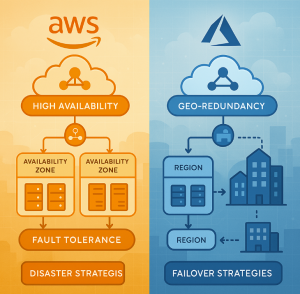
In today’s digital world, downtime isn’t just an inconvenience—it can cost your business customers, revenue, and reputation. Designing applications that are resilient and highly available is no longer optional. Both Amazon Web Services (AWS) and Microsoft Azure provide robust tools and services to help you implement patterns that ensure your systems can recover from failures and continue operating smoothly.
In this blog, we’ll explore key availability and resilience patterns and how you can implement them in AWS and Azure.
1. Failover Pattern
What it is:
The failover pattern automatically redirects traffic or services to a standby system when the primary one fails. This ensures continuity of service without manual intervention.
In AWS:
- Route 53 DNS Failover can detect endpoint health and switch traffic to a healthy backup region.
- Elastic Load Balancer (ELB) can span multiple Availability Zones, redirecting traffic if one zone fails.
- RDS Multi-AZ Deployment automatically switches to a standby replica during a failure.
In Azure:
- Traffic Manager uses DNS to route users to the most available endpoint across regions.
- Azure SQL Database supports active geo-replication with automatic failover.
- Azure Load Balancer supports zone-redundant failover within a region.
2. Health Endpoint Monitoring
What it is:
Applications and infrastructure components should regularly expose health check endpoints that monitoring tools use to assess their status and trigger recovery workflows if needed.
In AWS:
- CloudWatch Alarms can track health check metrics and trigger AWS Lambda functions or SNS alerts.
- ALB Health Checks determine instance availability and stop routing traffic to unhealthy ones.
- EC2 Auto Scaling Groups replace failed instances automatically based on health checks.
In Azure:
- Azure Monitor and Application Insights monitor health status and generate alerts.
- Azure Front Door performs active health probing and routes traffic away from unhealthy backends.
- Azure App Service has built-in health check endpoints for autoscale and instance replacement.
3. Retry Pattern with Exponential Backoff
What it is:
Transient failures—like timeouts or throttling—can often be resolved by retrying an operation after a short delay. Adding exponential backoff reduces the load during outages and prevents cascading failures.
In AWS:
- SDKs have built-in retry logic with backoff (e.g., AWS SDK for Java, Python).
- Services like AWS Step Functions can handle retries with defined intervals and failure strategies.
In Azure:
- Azure SDKs support built-in retry policies with exponential backoff.
- Azure Durable Functions support retry policies for activity failures.
- You can configure Azure Logic Apps with retry and timeout settings on connectors.
4. Circuit Breaker Pattern
What it is:
To prevent a system from continually trying to execute a failing operation (which worsens the problem), the circuit breaker pattern stops calls after a certain failure threshold. It resets after a timeout or manual intervention.
In AWS:
- Implement using AWS Lambda + Step Functions, or use libraries like Hystrix or Resilience4j in custom apps.
- Use API Gateway with Lambda Authorizers or WAF rules to enforce backoff manually.
In Azure:
- Use Polly in .NET applications to implement circuit breakers.
- Combine Azure API Management with Azure Functions or custom backoff logic.
- Monitor and disable routes or endpoints via Traffic Manager based on failure thresholds.
Designing for high availability and resilience is about planning for failure. Cloud platforms like AWS and Azure offer a wide range of tools and best practices to help you build systems that recover gracefully and stay online when things go wrong.
By adopting patterns like Failover, Health Monitoring, Retries, and Circuit Breakers, you can deliver better reliability, ensure customer trust, and maintain service levels—even under stress.
Whether you’re starting with a single-region app or scaling globally, resilience must be designed in—not bolted on. Use the patterns above as building blocks for your architecture and adapt them to meet your specific business and technical needs.
Extra posts:
 Building Resilient Systems with Immutable Infrastructure on AWS
  Building Resilient Systems with Immutable Infrastructure on Azure
  Scalability Patterns in the Cloud AWS & Azure Approaches
  Building a Fully Secure Architecture Integrating Azure OpenAI with APIM, Private Endpoints, and Applications
  Tracing the Cloud Thread Distributed Tracing Patterns for Microservices in AWS
  Follow the Thread Distributed Tracing Patterns for Microservices in Azure