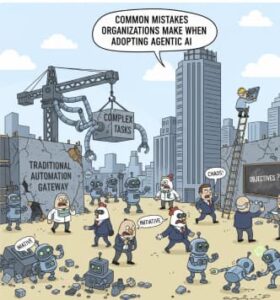
Agentic AI is quickly becoming one of the most talked-about innovations in enterprise technology. Unlike traditional automation tools, agentic systems can plan, reason, take initiative, and execute complex multi-step tasks with minimal human intervention. Powered by advances in large language models and autonomous decision frameworks, agentic AI promises to transform how organizations operate.
But here’s the hard truth: many organizations rush into adoption without fully understanding what they’re implementing. The result? Wasted budgets, frustrated teams, compliance risks, and AI initiatives that quietly fade away.
If your organization is exploring or actively implementing agentic AI, understanding the common pitfalls can save you time, money, and reputation. Below are the most frequent mistakes companies make — and what to do instead.
1. Treating Agentic AI Like Traditional Automation
One of the biggest mistakes organizations make is assuming agentic AI is just “smarter automation.”
Traditional automation follows predefined rules. Agentic AI, on the other hand, operates with goals, memory, reasoning capabilities, and adaptive planning. It doesn’t just execute scripts — it makes decisions.
When companies try to force agentic systems into rigid rule-based frameworks, they limit their value and create friction. Conversely, when they give agents too much autonomy without guardrails, they invite risk.
What to do instead:
- Redesign workflows to accommodate adaptive decision-making.
- Define clear boundaries, escalation rules, and monitoring mechanisms.
- Treat agentic AI as a collaborative actor, not a static tool.
2. Failing to Define Clear Objectives
Many organizations adopt agentic AI because of hype or competitive pressure. The leadership mandate is often vague: “We need AI agents.”
Without clearly defined business objectives, teams struggle to measure success. Is the goal cost reduction? Faster service delivery? Revenue growth? Improved compliance?
Agentic AI implementations fail when they are solutions looking for problems.
What to do instead:
- Identify high-friction, repetitive, or decision-heavy processes.
- Define measurable KPIs before deployment.
- Start with a focused pilot rather than a sweeping enterprise rollout.
3. Ignoring Data Quality and System Integration
Agentic AI systems are only as good as the data and systems they interact with. Organizations frequently underestimate the complexity of integrating agents into legacy environments.
Disconnected systems, inconsistent data formats, and poor data hygiene can cause agents to make flawed decisions or generate unreliable outputs.
Common oversight: Assuming the AI will “figure it out.”
What to do instead:
- Audit your data infrastructure before implementation.
- Ensure API readiness and structured access to key systems.
- Establish data governance frameworks early.
4. Overestimating Autonomy, Underestimating Oversight
Agentic AI sounds autonomous — and it is. But autonomy without oversight can lead to serious issues, especially in regulated industries.
Agents can hallucinate, misinterpret instructions, or pursue unintended strategies if guardrails aren’t in place. Organizations that assume the system can operate independently without supervision often face unexpected errors or compliance violations.
What to do instead:
- Implement human-in-the-loop review systems.
- Use monitoring dashboards and audit trails.
- Define risk tiers for different agent actions.
Autonomy should scale gradually, not instantly.
5. Neglecting Governance and Compliance
As agentic AI systems make decisions that impact customers, finances, and operations, governance becomes critical. Unfortunately, many organizations bolt governance on after deployment.
This reactive approach can create regulatory exposure, especially under evolving AI regulations such as the EU AI Act, which emphasizes risk classification, transparency, and accountability.
What to do instead:
- Establish AI governance committees early.
- Document decision logic and training methodologies.
- Perform regular bias and risk assessments.
- Align implementation with global compliance frameworks.
Governance isn’t a barrier to innovation — it’s a safeguard for sustainable adoption.
6. Underinvesting in Change Management
Technology adoption is rarely a technical failure; it’s a human one.
Agentic AI can change workflows, decision rights, and job roles. Employees may feel threatened or confused. Leaders may misunderstand capabilities. Without structured change management, resistance grows quietly.
Common symptoms:
- Teams bypassing the AI.
- Shadow workflows.
- Lack of trust in outputs.
What to do instead:
- Communicate the purpose and benefits clearly.
- Provide hands-on training.
- Position AI agents as augmenting, not replacing, human expertise.
- Create feedback loops for continuous improvement.
Successful AI transformation is as much cultural as it is technological.
7. Expecting Immediate ROI
Agentic AI is powerful, but it is not magic. Many organizations expect immediate cost savings or productivity boosts.
In reality, early phases often involve:
- Prompt tuning.
- Workflow redesign.
- Error handling refinement.
- Iterative testing.
Companies that abandon initiatives too early miss long-term value.
What to do instead:
- Plan for phased ROI.
- Set realistic expectations for learning curves.
- Track both quantitative and qualitative improvements.
Think of agentic AI adoption as capability building, not a quick cost-cutting exercise.
8. Building Without Security by Design
Agentic systems often require access to sensitive data and operational tools. If security isn’t embedded from day one, organizations risk data breaches or unintended actions.
Security concerns are amplified when agents:
- Execute transactions.
- Access financial records.
- Send communications on behalf of the company.
What to do instead:
- Apply role-based access controls.
- Use sandbox environments during testing.
- Conduct red-team simulations.
- Implement strict authentication and authorization protocols.
Security must evolve alongside autonomy.
9. Over-Customizing Too Early
Another common mistake is overengineering the first deployment. Organizations sometimes try to build a fully customized, enterprise-wide agentic ecosystem before validating basic use cases.
This increases complexity, delays deployment, and inflates costs.
What to do instead:
- Start with modular agents.
- Validate one workflow at a time.
- Scale based on proven performance.
Simplicity accelerates learning.
10. Failing to Monitor Long-Term Performance
Agentic AI systems evolve through interaction. Over time, business environments, policies, and data inputs change.
Without continuous monitoring, performance may degrade or drift from original objectives.
What to do instead:
- Establish ongoing evaluation metrics.
- Schedule regular retraining and optimization cycles.
- Monitor bias, hallucinations, and decision anomalies.
AI deployment is not a one-time project — it’s an operational discipline.
The Strategic Mindset Shift
At its core, adopting agentic AI requires a mindset shift:
- From automation to collaboration.
- From static workflows to adaptive systems.
- From control-only models to guided autonomy.
Organizations that succeed understand that agentic AI is neither a plug-and-play solution nor a fully independent decision-maker. It’s a dynamic partner that must be carefully integrated into governance structures, operational processes, and cultural frameworks.
Turning Mistakes into Competitive Advantage
The adoption of agentic AI presents enormous opportunity. Companies that implement it thoughtfully can unlock:
- Faster decision cycles
- Operational efficiency
- Scalable expertise
- Competitive differentiation
But those that rush without strategy often encounter avoidable setbacks.
By defining clear objectives, prioritizing governance, investing in change management, and scaling deliberately, organizations can avoid common pitfalls and build resilient, responsible AI ecosystems.
Agentic AI isn’t just a technological upgrade — it’s an organizational transformation. And like any transformation, success depends less on the tool itself and more on how wisely it’s deployed.
Extra posts:
 AI Mistakes in Microsoft Copilot and How to Fix Them
  Common Mistakes When Upgrading from Older Office Versions to Microsoft 365
  Data Boundaries and Permissions in an Agentic Copilot World
  The “Agentic” Intranet: Securing and Scaling M365 Copilot with SharePoint & Teams
  Designing and Creating Agentic AI in Azure
  How Agentic AI Works and How to Build It in Azure