📘 What is Blockchain?
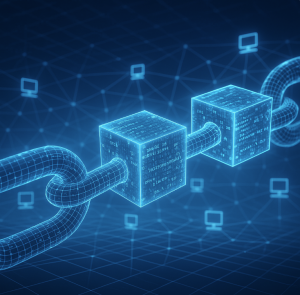
At its core, blockchain is a distributed, immutable ledger used to record digital transactions across a network of computers. Instead of relying on a centralized database, blockchain stores information in a peer-to-peer (P2P) system, where every participant (node) has a copy of the ledger.
It gets its name from its data structure: a chain of blocks, where each block contains a list of transactions and a reference (hash) to the previous block, forming a secure, time-stamped sequence.
🧱 Key Components
| Component | Description |
|---|---|
| Block | A data container holding a list of validated transactions |
| Hash | A unique cryptographic fingerprint for a block (using SHA-256, for example) |
| Previous Hash | Links the block to its predecessor, creating the chain |
| Timestamp | Records the exact time the block was created |
| Nonce | A random number used in Proof-of-Work (PoW) to mine a block |
| Merkle Root | A single hash that summarizes all transactions in the block |
⚙️ How Blockchain Works (Step-by-Step)
- A Transaction is Initiated
A user sends digital assets (like cryptocurrency) to another user. - Transaction is Broadcast
The transaction is sent to a P2P network of nodes (computers running the blockchain protocol). - Validation Process Begins
Nodes validate the transaction using consensus algorithms such as:- Proof of Work (PoW) – solving a cryptographic puzzle (used in Bitcoin).
- Proof of Stake (PoS) – validators are chosen based on the amount of stake.
- Practical Byzantine Fault Tolerance (PBFT) – used in permissioned blockchains.
- Block Creation
Validated transactions are grouped into a block. The block includes:- All valid transactions.
- Hash of the previous block.
- Merkle root of transactions.
- Nonce (if using PoW).
- Block is Added to the Chain
The new block is broadcast to the network and added to each node’s copy of the blockchain. - Transaction is Finalized
Once the block is added, the transaction is considered confirmed and immutable.
🔐 Why is Blockchain Secure?
- Hashing & Cryptography: Tampering with a block changes its hash, breaking the chain.
- Decentralization: No single point of failure; data is shared and synced across all nodes.
- Consensus: Ensures agreement across participants before a new block is added.
- Immutability: Once recorded, transactions cannot be altered without redoing all following blocks.
🧠 Real-World Use Cases
| Sector | Use Case |
|---|---|
| Finance | Cryptocurrencies, cross-border payments, asset tokenization |
| Supply Chain | Track goods, reduce fraud, improve transparency |
| Healthcare | Secure medical records sharing |
| Voting | Transparent, tamper-proof digital voting systems |
| Legal | Smart contracts to automate and enforce agreements |
| Identity | Self-sovereign digital identity |
🔄 Types of Blockchain
| Type | Description | Example |
|---|---|---|
| Public | Open to all, fully decentralized | Bitcoin, Ethereum |
| Private | Controlled by a single entity or group | Hyperledger Fabric |
| Consortium | Controlled by a group of organizations | R3 Corda, Quorum |
| Hybrid | Combination of public and private features | Dragonchain |
🧰 Tools and Technologies to Know
- Blockchain Platforms: Ethereum, Hyperledger, Corda, Solana, Polygon
- Smart Contracts: Self-executing code on a blockchain (mainly on Ethereum using Solidity)
- Wallets: Store public/private keys (e.g., MetaMask, Ledger)
- Explorers: View blockchain data (e.g., Etherscan, Blockchain.com)
✅ Summary
Blockchain = Decentralization + Cryptography + Consensus + Transparency
Blockchain introduces a trustless model: participants don’t need to trust each other—they trust the code, the math, and the network.
It’s a foundational technology that’s transforming how we handle data, ownership, identity, and agreements across the digital world.
Extra posts:
 How to Take Screenshots on Windows 11 (All Methods Explained)
  Windows 11 System Requirements Explained Simply
  Architecture vs. Design Key Differences Explained
  AI Terms Explained for Microsoft 365 Users
  Public vs Private vs Hybrid Cloud Models Explained
  Microsoft 365 Copilot Licensing Shake-Up Explained