
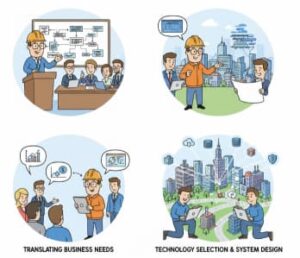
In today’s fast-paced digital landscape, businesses rely on technology to stay competitive, improve efficiency, and adapt to evolving market demands. But behind every successful digital solution—whether it’s a cloud migration, enterprise software deployment, or complex system integration—stands a professional who ensures that the technology is not only functional, but also aligned with business goals. This professional is the Solution Architect.
A Solution Architect plays a vital role in bridging the gap between business needs and technology capabilities. They design the blueprint that enables organizations to implement reliable, scalable, and secure solutions. Their job goes far beyond selecting the right tools; it requires deep technical expertise, strong communication skills, and a holistic understanding of how different systems work together.
Below are the core responsibilities of a Solution Architect and why this role is essential in modern organizations.
1. Understanding Business Requirements
One of the primary responsibilities of a Solution Architect is to thoroughly understand the organization’s business objectives. This involves gathering requirements from stakeholders, analyzing business processes, and interpreting high-level needs into technical specifications.
A Solution Architect often collaborates closely with executives, project managers, and department leads to ensure they fully grasp the challenges and opportunities at hand. Their ability to translate business language into actionable technical plans makes them a crucial part of any IT project.
Understanding business requirements ensures that the proposed solution does not simply “work”—it works for the business.
2. Designing End-to-End Technical Architecture
A Solution Architect is essentially the creator of the system’s blueprint. They design the overall architecture that guides the development and implementation of the solution. This may include:
- Choosing appropriate technology stacks
- Determining integration methods
- Structuring data flow and APIs
- Setting performance and scalability standards
- Creating diagrams and documentation
Their technical design must align with both current needs and future growth. The architecture must be flexible, maintainable, and scalable so the organization can evolve without major architectural changes.
This responsibility demands deep technical knowledge across multiple domains such as cloud platforms, cybersecurity, databases, networking, and software development frameworks.
3. Ensuring Solution Alignment with Enterprise Standards
Most organizations have established IT standards, frameworks, and guidelines. A Solution Architect ensures the proposed solution aligns with these enterprise rules. This includes:
- Compliance with security policies
- Adherence to regulatory requirements
- Following best practices for development and deployment
- Ensuring compatibility with existing systems
By maintaining alignment with enterprise architecture standards, Solution Architects protect the organization from unnecessary risks and avoid the chaos that comes with system fragmentation.
4. Selecting the Right Technologies
Technology evolves rapidly, and organizations look to Solution Architects to make informed decisions about which tools and platforms to use.
This includes evaluating:
- Cloud providers (AWS, Azure, Google Cloud)
- Programming languages and frameworks
- Database technologies
- Third-party integrations
- Infrastructure and DevOps tools
Their decisions have long-term implications on cost, performance, and maintainability. Therefore, a Solution Architect must be both technically knowledgeable and aware of market trends.
5. Guiding Development Teams
Solution Architects frequently act as mentors and technical leaders for development teams. While they may not write every line of code, they provide essential guidance to ensure the team builds the system according to the architectural plan.
Their responsibilities may include:
- Clarifying technical requirements
- Reviewing design documents
- Providing best-practice recommendations
- Troubleshooting complex issues
- Supporting DevOps and deployment teams
This leadership ensures that the technical vision is maintained throughout the project lifecycle.
6. Managing Risks and Ensuring System Security
Security is one of the most important aspects of any modern solution, and Solution Architects play a key role in identifying and mitigating risks. They assess potential vulnerabilities in the system’s architecture and design ways to address them.
Common security considerations include:
- Data encryption
- Identity and access management
- Network security
- Compliance with standards such as GDPR, HIPAA, or ISO
A well-architected solution minimizes the risk of costly security breaches and ensures the organization’s data remains protected.
7. Facilitating Communication Between Stakeholders
A Solution Architect is a communicator as much as they are a technical expert. They bridge the gap between business stakeholders, developers, designers, vendors, and project managers. Their ability to express complex technical concepts in simple terms makes them essential to smooth project execution.
Effective communication helps:
- Set realistic expectations
- Reduce misunderstandings
- Speed up decision-making
- Build trust across teams
Because of this, strong interpersonal skills are just as important as technical proficiency.
8. Overseeing Implementation and Ensuring Quality
Solution Architects stay actively involved during the implementation phase. They monitor the progress of development, validate technical decisions, and ensure that the solution is being built according to the approved architecture.
Quality assurance is another major responsibility. Solution Architects validate that:
- The system meets performance benchmarks
- Integrations function correctly
- The solution is scalable and maintainable
- All business requirements have been addressed
Before the system goes live, they often participate in testing, reviews, and final approvals.
9. Continuous Improvement and Optimization
Even after deployment, the job isn’t done. A Solution Architect often evaluates system performance and identifies opportunities for improvement. As the business grows or technology evolves, they may refine the architecture or recommend new enhancements.
This ensures the solution remains efficient, secure, and relevant over time.
The role of a Solution Architect is multifaceted and essential. By combining deep technical expertise with strong business understanding and leadership skills, they ensure that organizations implement solutions that are not only functional but also future-proof. Their work shapes the technical foundation of modern enterprises and plays a pivotal role in digital transformation.
Whether designing a cloud migration strategy, integrating complex systems, or ensuring long-term scalability, Solution Architects bring clarity, structure, and innovation to the table. They are the guiding force that ensures technology works in harmony with business goals.
Extra posts:
 Can the Solution Architect Role Be Replaced by AI?
  Microservice Architecture Drawbacks and How to Solve Them: A Solution Architect’s Perspective
  Trade-Off Analysis in Architecture: A Practical Guide from a Solution Architect
  Supercharging Solution Architecture with GitHub Copilot Prompts Every Architect Should Know
  The Role of a Software Architect in Modern Teams
  The Evolving Blueprint: What’s Next for the Software Architect Role?