

Artificial intelligence is no longer a futuristic investment it’s an operational necessity. From automating customer support to accelerating software development, AI copilots and agents are reshaping how companies function. But with multiple approaches available, decision-makers are facing a critical question:
Should we adopt ChatGPT, integrate Microsoft Copilot, or build custom AI agents?
The answer isn’t one-size-fits-all. It depends on your tech stack, data sensitivity, scalability needs, and long-term strategy. Let’s break down each option and explore how companies can make the right choice.
Understanding the Three Approaches
Before comparing, it’s important to clarify what each solution represents.
ChatGPT (by OpenAI) is a flexible, general-purpose AI assistant that can be adapted across industries—from content creation to coding support.
Microsoft Copilot is a suite of AI tools embedded directly into the Microsoft ecosystem (like Word, Excel, Teams, and Azure), designed to enhance productivity within familiar workflows.
Custom AI Agents are bespoke solutions built using APIs, frameworks, and proprietary data to perform highly specific tasks tailored to a company’s needs.
ChatGPT: Flexible, Powerful, and Rapid to Deploy
ChatGPT has quickly become a go-to solution for organizations seeking immediate AI capabilities without heavy development overhead.
Strengths
- Ease of adoption: Teams can start using ChatGPT almost instantly.
- Versatility: It supports a wide range of use cases marketing, coding, customer service, research, and more.
- Continuous improvement: Regular updates bring better reasoning, multimodal capabilities, and integrations.
Limitations
- Customization constraints: While APIs allow fine-tuning, deep enterprise-specific workflows may require additional layers.
- Data governance concerns: Companies must carefully manage how sensitive data is handled.
- Dependency on external platform: You rely on OpenAI’s infrastructure and roadmap.
Best Fit
ChatGPT is ideal for companies that:
- Want fast ROI with minimal setup
- Need cross-functional AI assistance
- Are experimenting with AI before committing to deeper investments
Microsoft Copilot: Deep Integration with Enterprise Workflows
Microsoft Copilot stands out for its seamless integration with tools businesses already use daily.
Strengths
- Native integration: Works directly within Word, Excel, Outlook, Teams, and more.
- Enterprise-grade security: Built on Microsoft’s compliance and identity infrastructure.
- Contextual intelligence: Leverages organizational data through Microsoft Graph.
Limitations
- Ecosystem lock-in: Most valuable for organizations already deeply invested in Microsoft.
- Less flexibility: Compared to open APIs, customization is more structured and sometimes limited.
- Licensing costs: Pricing can scale quickly depending on usage.
Best Fit
Copilot is ideal for companies that:
- Already rely heavily on Microsoft 365 and Azure
- Prioritize security and compliance
- Want AI embedded directly into existing workflows rather than building new ones
Custom AI Agents: Maximum Control and Strategic Differentiation
Custom AI agents represent the most advanced and resource-intensive approach.
Strengths
- Full customization: Tailored to specific workflows, data, and business logic
- Competitive advantage: Unique AI capabilities can differentiate your business
- Data ownership: Greater control over how data is processed and stored
Limitations
- High development cost: Requires engineering talent, infrastructure, and ongoing maintenance
- Longer time-to-value: Building and refining agents takes time
- Operational complexity: Monitoring, scaling, and updating agents adds overhead
Best Fit
Custom agents are ideal for companies that:
- Have unique workflows not supported by off-the-shelf tools
- Operate in highly regulated or data-sensitive environments
- View AI as a core competitive advantage rather than a utility
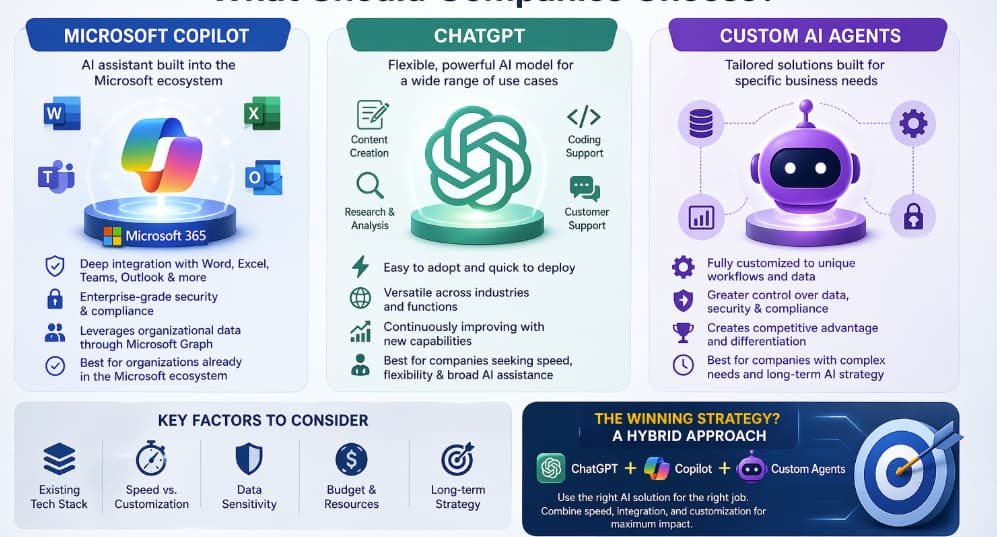
Key Decision Factors for Companies
When choosing between ChatGPT, Copilot, and custom agents, consider the following:
1. Existing Tech Stack
- If you’re deeply embedded in Microsoft → Copilot is a natural fit
- If you use diverse tools → ChatGPT or custom agents offer more flexibility
2. Speed vs Customization
- Need immediate deployment → ChatGPT
- Need tailored workflows → Custom agents
3. Data Sensitivity
- High compliance requirements → Copilot or private custom agents
- Lower sensitivity → ChatGPT can be sufficient
4. Budget and Resources
- Limited engineering capacity → ChatGPT or Copilot
- Strong technical team → Custom agents become viable
5. Long-Term Strategy
- AI as a productivity tool → Copilot or ChatGPT
- AI as a competitive moat → Custom agents
A Hybrid Future: The Real Winning Strategy
For most companies, the answer isn’t choosing just one it’s combining them strategically.
A typical modern AI stack might look like:
- ChatGPT for general-purpose tasks and experimentation
- Microsoft Copilot for internal productivity within Office tools
- Custom agents for core business processes (e.g., customer support automation, fraud detection, internal knowledge systems)
This hybrid approach allows organizations to balance speed, control, and scalability.
here is no universally “best” choice only the best fit for your organization’s needs.
- Choose ChatGPT if you want speed, flexibility, and broad capabilities
- Choose Microsoft Copilot if you want seamless integration and enterprise-grade security
- Choose Custom Agents if you want differentiation, control, and long-term strategic advantage
The companies that win won’t just adopt AI they’ll architect it thoughtfully across their organization.
AI is no longer a single tool it’s an ecosystem decision. Whether you lean toward open platforms, closed ecosystems, or fully custom-built agents, the key is aligning your choice with your business goals, technical maturity, and future ambitions.
The smartest move? Start small, learn fast, and scale strategically.
Extra posts:
 Human-in-the-Loop: Where Copilot Agents Should (and Shouldn’t) Act Alone
  The Difference Between Declarative Agents and Autonomous Agents in Copilot Studio
  Creating Custom Plugins and Connectors in Copilot Studio
  The Daily Stand-Up Agent A Custom Copilot for Summarizing Jira & Azure DevOps Progress
  Copilot Studio vs Azure AI Agents: What Should You Use?
  Governance of AI Agents with Microsoft Entra & Agent 365