
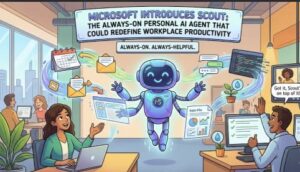
Microsoft has officially unveiled Microsoft Scout, a new AI-powered personal agent designed to work continuously in the background and help users manage tasks, schedules, communications, and workflows across the Microsoft 365 ecosystem. Announced on June 2, 2026, Scout represents Microsoft’s latest step toward autonomous AI agents that move beyond traditional chatbot interactions and actively help users get work done.
The launch marks the introduction of a new category of AI systems that Microsoft calls “Autopilots” always-on agents capable of operating independently while remaining under user and organizational control. Unlike conventional AI assistants that wait for prompts, Scout is designed to proactively monitor work activities, identify priorities, and take action when needed.
A New Era of Autonomous AI Assistance
For years, AI assistants have largely functioned as reactive tools. Users ask a question, request a summary, or generate content, and the AI responds. Microsoft believes the next stage of AI evolution is moving beyond one-time interactions toward persistent agents that can continuously assist users throughout the workday.
According to Microsoft, Scout is built to remain active in the background, maintaining awareness of ongoing projects, meetings, deadlines, and communications. Rather than requiring repeated instructions, the agent can carry work forward autonomously while operating within predefined permissions and security policies.
The company describes this as a shift from “answering questions” to “following through on tasks,” enabling professionals to spend less time coordinating work and more time focusing on strategic activities.
What Is Microsoft Scout?
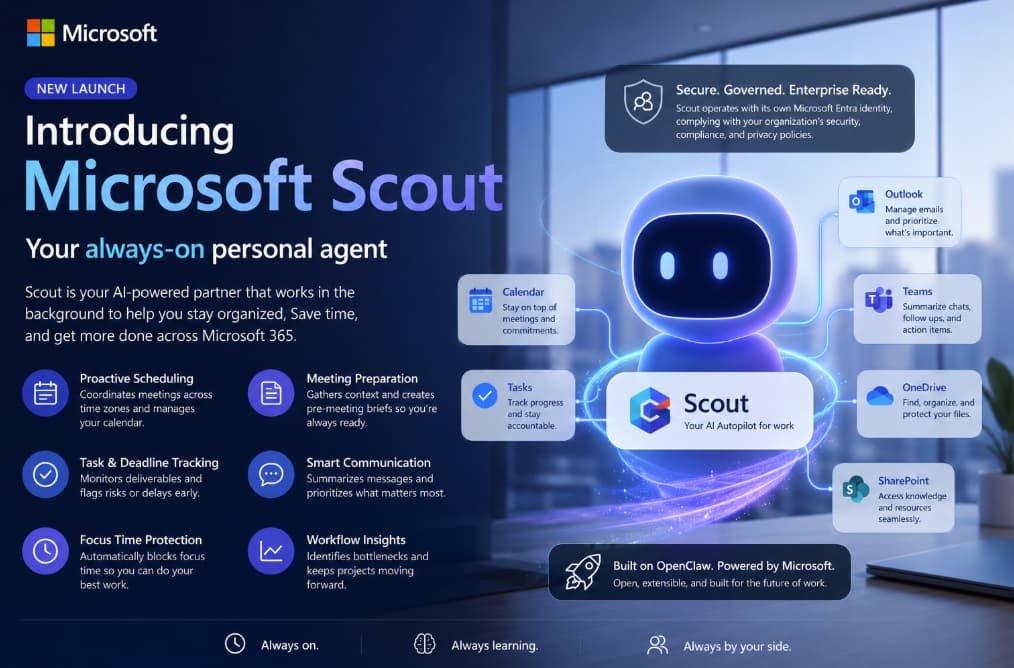
Microsoft Scout is Microsoft’s first Autopilot agent and is deeply integrated into Microsoft 365 applications. The platform connects with commonly used services such as Teams, Outlook, OneDrive, and SharePoint while drawing context from emails, chats, calendars, contacts, and organizational data.
Users primarily interact with Scout through Microsoft Teams, although it can extend its capabilities through desktop applications, browsers, local resources, and Model Context Protocol (MCP) servers. This broad integration allows Scout to access the information needed to understand ongoing work and act accordingly.
Unlike Microsoft 365 Copilot, which typically responds to user requests, Scout is intended to function more like a digital coworker that remains available around the clock. Industry observers have described Scout as a significant step toward AI systems that proactively manage work instead of merely assisting with isolated tasks.
Key Features and Capabilities
One of Scout’s most notable features is its ability to proactively coordinate work activities. Microsoft says the agent can:
- Schedule and coordinate meetings across multiple time zones.
- Identify and flag important upcoming meetings.
- Generate preparation materials before meetings occur.
- Track project deliverables and deadlines.
- Automatically block focus time on calendars.
- Detect stalled decisions and potential workflow bottlenecks.
- Help manage communications and administrative tasks.
As Scout continues working with a user, it develops a deeper understanding of individual preferences, priorities, and working patterns. This growing contextual awareness is powered by Microsoft’s Work IQ technology, which enables the agent to learn how users operate and become increasingly personalized over time.
The goal is to create an assistant that not only understands what needs to be done but also understands how a specific user prefers work to be completed.
Built on OpenClaw Technology
A particularly interesting aspect of Scout is its foundation. Microsoft revealed that Scout is powered by OpenClaw, an open-source agent framework that gained significant attention in the AI community earlier this year.
OpenClaw became known for enabling highly autonomous AI agents capable of interacting with software systems, websites, and workflows. However, it also sparked discussions about safety, reliability, and governance due to the complexity of autonomous AI behavior.
Microsoft’s approach has been to combine OpenClaw’s flexibility with enterprise-grade security, compliance controls, and identity management. The company is also contributing policy conformance capabilities back to the open-source community, allowing organizations to verify that their AI environments meet security and compliance requirements.
Enterprise Security at the Core
Given the autonomous nature of Scout, security and governance are central to Microsoft’s strategy.
Each Scout agent operates with its own governed Microsoft Entra identity rather than using shared credentials. This provides clear accountability for every action performed by the AI system. Organizations can determine what resources agents may access and what actions require human approval before execution.
Microsoft also states that Scout operates within existing compliance frameworks, including Microsoft Purview policies, sensitivity labels, and data loss prevention controls. Sensitive information remains protected, and administrators retain oversight of AI activities.
These safeguards are designed to address concerns that autonomous AI agents could act unpredictably or gain inappropriate access to organizational data.
Early Adoption and Availability
Microsoft reports that more than 3,000 employees have already been using early versions of Scout internally. According to the company, the agent has been assisting with scheduling, travel planning, coordination tasks, and workflow management across departments.
The company is now expanding access through a private preview program and its Frontier initiative, which provides early access to emerging Microsoft technologies. To participate, organizations must enroll in Frontier, configure Intune policies, and complete an opt-in attestation process. Users also require a GitHub Copilot license to access the current experimental release.
While availability remains limited for now, Scout is widely viewed as an early glimpse into Microsoft’s broader vision for AI-powered workplace automation.
Why Microsoft Scout Matters
The introduction of Scout signals a major shift in Microsoft’s AI strategy. Rather than focusing solely on generative AI that responds to prompts, the company is investing in agents capable of carrying out ongoing responsibilities on behalf of users.
This approach aligns with a broader industry trend toward agentic AI—systems that can observe, reason, plan, and act independently while remaining aligned with human goals. As businesses increasingly seek ways to automate repetitive work and improve productivity, tools like Scout could become a key part of the modern workplace.
Whether Scout ultimately becomes the standard for AI-powered work assistants remains to be seen. However, its launch demonstrates that Microsoft is betting heavily on a future where AI agents operate as persistent digital collaborators rather than simple productivity tools.
For organizations already invested in Microsoft 365, Scout could represent one of the most significant workplace AI innovations introduced since the arrival of Copilot.
Extra posts:
 Microsoft Teams Introduces AI Meeting Recap Without Transcripts, Helping Organizations Balance Productivity and Compliance
  Learning Agent by Microsoft: The Future of Personalized AI-Powered Employee Upskilling Has Arrived
  Unlocking Workplace Productivity with Microsoft Viva Insights
  Microsoft Launches Agent 365 to Bring Control, Security, and Visibility to the Age of AI Agents
  What Is Microsoft 365 Agent Builder? A Beginner’s Guide
  Turning Widgets into a Personal Productivity Dashboard in Windows 11