
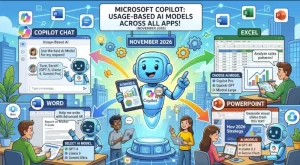
Microsoft is preparing to expand access to advanced AI models across its Microsoft Copilot ecosystem, introducing usage-based billing (UBB) for GPT-6 Astra and Claude Fable 5.1 in Copilot Chat, Word, Excel and PowerPoint. The worldwide rollout is scheduled to begin in early November 2026 and is expected to finish by mid-November.
The update will give eligible Microsoft 365 Copilot users another way to access AI models through a model selector. However, availability will depend on an organization’s billing configuration, user licensing and allocation of Copilot credits.
For IT administrators, the announcement introduces an important operational consideration: making advanced AI models available will require more than simply enabling a feature. Organizations will need to establish access policies, allocate credits and prepare for how users will request additional capacity once their assigned credits run out.
Microsoft Copilot Usage-Based Billing: What’s Changing?
The planned rollout extends usage-based billing models to several of Microsoft’s core productivity experiences. According to the announcement, users who meet the eligibility requirements will be able to select supported models from Copilot Chat and while working in Word, Excel and PowerPoint.
Two models are included in this phase:
- GPT-6 Astra: An OpenAI model made available through Microsoft Copilot under the usage-based billing arrangement.
- Claude Fable 5.1: An Anthropic model that will also be available through the same billing framework.
The change is intended to give organizations access to additional AI options within their existing Microsoft productivity environment, subject to the applicable eligibility requirements.
Importantly, this is not an automatic upgrade for every Copilot user. Microsoft states that usage-based billing must be enabled before users can access these models, and eligible users must have the required Microsoft 365 Copilot user subscription license and allocated credits.
The rollout follows Microsoft’s previously communicated plans for usage-based billing, referenced in its announcement MC1479276.
When Will the New Copilot Models Become Available?
Microsoft’s published schedule identifies a worldwide general availability window beginning in early November 2026, with completion expected by mid-November.
The rollout covers the following services and administrative areas:
- Microsoft Copilot and Copilot Chat
- Copilot in Word
- Copilot in Excel
- Copilot in PowerPoint
- Agent 365 cost management in the Microsoft 365 admin center
Organizations should plan for the stated rollout window rather than assume that every eligible user will see the new models on the first day.
Administrators should also review Microsoft’s current documentation before deployment, particularly where licensing, billing configuration and credit management affect access.
How Usage-Based Billing Will Work
The central feature of this announcement is the distinction between having a Microsoft 365 Copilot license and having access to models covered by usage-based billing.
Under the announced arrangement, organizations must enable UBB and allocate credits to the users who should be able to use these models. The model selector will then provide access to the supported options for eligible users.
In practice, administrators will need to coordinate three elements:
- Licensing: Confirm that intended users hold the required Microsoft 365 Copilot user subscription license.
- Access configuration: Enable usage-based billing for the appropriate users.
- Credit allocation: Assign Copilot credits to users who need access to the UBB models.
These requirements create a more deliberate approach to deploying advanced AI capabilities. Rather than granting unrestricted access across the organization by default, administrators can make decisions about which users receive access and how credits are distributed.
However, the announcement does not specify the exact credit consumption rates for GPT-6 Astra or Claude Fable 5.1. Organizations should consult Microsoft’s applicable billing documentation before estimating costs or setting individual credit budgets.
What This Means for Word, Excel and PowerPoint Users
Bringing usage-based models into familiar Microsoft 365 applications could change how employees approach AI-assisted work.
In Word, users will be able to access eligible models while working within the document experience. In Excel, the expanded model selection will be available within the spreadsheet workflow, while PowerPoint users will have access to the supported models in the presentation environment.
Copilot Chat will also offer the models through its selector, giving users another place to access them.
The practical benefit is the ability to select from additional supported AI models without necessarily leaving the Microsoft productivity environment. This may be useful for organizations that want to make different model options available to employees while keeping their work within established Microsoft 365 workflows.
Still, the announcement does not establish that one model will outperform the other for a particular task. Nor does it provide comparative benchmark results, detailed feature specifications or guaranteed productivity improvements. Those questions will need to be evaluated against Microsoft’s model documentation and each organization’s real-world requirements.
For employees, the immediate difference may simply be the appearance of additional choices in the model selector. Whether those choices are available will depend on the organization’s configuration and the user’s assigned credits.
Why IT Administrators Need to Prepare Now
For IT teams, the most consequential part of the announcement is the administrative work that precedes access.
Enabling UBB without a clear governance plan could make it harder to anticipate consumption, manage budgets or respond consistently when users exhaust their allocated credits. Microsoft’s guidance therefore emphasizes reviewing organizational governance requirements, expected usage and anticipated credit consumption before assigning credits.
Administrators should consider the following preparation steps:
- Audit eligibility: Identify users with the required Microsoft 365 Copilot subscription license.
- Define access policies: Determine which teams or employees have a business need for usage-based models.
- Establish credit budgets: Allocate credits according to expected usage and organizational priorities.
- Review governance requirements: Confirm that the deployment aligns with internal AI, data access and cost management policies.
- Prepare user communications: Explain how access works, how credit limits affect availability and what users should do when credits are depleted.
- Review Microsoft’s documentation: Validate setup procedures, billing rules and credit management requirements before enabling the service.
These steps can help organizations avoid treating model availability as a purely technical rollout. UBB also introduces financial and operational decisions that should be addressed before employees begin using the new options.
Additional Credits: A Future Development to Watch
Microsoft also plans to introduce a way for users to request additional credits from their tenant administrators after the initial rollout.
That capability is not described as part of the initial availability phase. Organizations should therefore prepare their own process for handling exhausted credits rather than assume that users will immediately have an integrated request workflow.
A defined process could specify who reviews requests, how additional allocations are approved and which business needs justify extra credits. IT and finance teams may also want to monitor consumption patterns before adjusting budgets.
The future request feature could make ongoing credit management more convenient, but its rollout timing and detailed workflow are not specified in the supplied announcement.
Security, Data Access and Compliance Considerations
Microsoft’s announcement identifies the update as a change involving AI capabilities that interact with customer data.
When users access UBB models through Copilot Chat or Microsoft 365 applications, those models process prompts and Microsoft 365 data made available through Copilot according to existing permissions and configuration.
This means organizations should assess the rollout within their current data governance framework. Relevant considerations include which users can access particular information, how AI usage aligns with internal policies and whether the selected users should receive access to usage-based models.
The announcement confirms that administrators control access through UBB enablement and credit allocation. However, it does not confirm whether every aspect of this access can be scoped through Microsoft Entra ID group membership. Organizations that require group-based controls should verify the supported configuration in Microsoft’s official documentation rather than assume that capability is available.
As with any expansion of enterprise AI access, credit management and data governance should be treated as related but distinct responsibilities. Allocating credits determines who can use the supported models under the billing arrangement; existing data permissions and configuration continue to govern the information made available through Copilot.
What Organizations Should Watch Next
The November rollout is the first milestone, but several details will matter as organizations decide how broadly to deploy the new models.
First, administrators will need clear information about model-specific credit consumption and the resulting cost of common workloads. Without reliable usage estimates, setting appropriate allocations may require an initial monitoring period and subsequent adjustments.
Second, organizations should watch for Microsoft’s additional-credit request capability. Its availability and implementation details will influence how businesses handle employees who reach their assigned limits.
Third, IT teams will need to assess whether the expanded model selector offers meaningful value for their particular workflows. The availability of multiple models creates additional choice, but organizations should evaluate those options using their own performance, governance and cost requirements.
Finally, Microsoft’s documentation on usage-based billing, credit setup and the user subscription license will remain important for deployment planning. Administrators should verify current requirements as the rollout approaches.
The key issue is not simply whether GPT-6 Astra and Claude Fable 5.1 appear in Copilot. It is whether organizations can make those models available under a clear, manageable framework for licensing, access, spending and data governance.
As Microsoft moves toward the planned November 2026 availability window, businesses that establish those controls early will be better positioned to evaluate the new options and make informed decisions about who should use them.
Extra posts:
 Microsoft 365 Copilot Gets a Faster Way to Work in Word, Excel and PowerPoint
 Microsoft Copilot Pricing Is Changing: Usage-Based Billing and New FinOps Controls Arrive
 How to Create Reusable Templates in Word, Excel, and PowerPoint
 Microsoft 365 Copilot Chat Skills: Features, Admin Controls, and October 2026 Rollout
 Microsoft 365 Copilot Gets an Outlook Upgrade: Draft Emails Right Inside Copilot Chat on Mobile
 Microsoft 365 Copilot in PowerPoint Gets Stricter Brand Control With Notes Steering