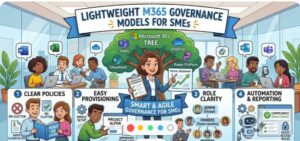
Governance in Microsoft 365 (M365) often gets a bad reputation. For many small-to-mid-sized organizations, it conjures images of rigid policies, endless approval workflows, and heavy administrative overhead. But governance doesn’t have to be complicated—or burdensome—to be effective.
In reality, smaller organizations need governance just as much as large enterprises. The difference is in how it’s implemented. Instead of adopting enterprise-scale frameworks that slow things down, small-to-mid-sized businesses benefit most from lightweight governance models—approaches that provide structure and security while staying flexible and easy to manage.
This article explores how to design and implement a streamlined governance model for your M365 tenant without overengineering the process.
Why Governance Still Matters (Even for Smaller Tenants)
It’s tempting to think governance is optional when your organization has fewer users or simpler workflows. However, even a modest M365 environment can quickly become chaotic without basic controls in place.
Common issues include:
- Uncontrolled creation of Teams and SharePoint sites
- Sensitive data being overshared externally
- Lack of ownership for content and collaboration spaces
- Difficulty locating important documents
- Security risks due to inconsistent policies
Lightweight governance addresses these risks without introducing unnecessary complexity.
Principles of Lightweight Governance
Before diving into implementation, it’s important to understand the core principles behind a lightweight governance model:
1. Simplicity Over Perfection
You don’t need to cover every edge case. Focus on the most common risks and workflows first.
2. Automation Where Possible
Manual processes don’t scale—even in small environments. Use built-in automation tools in M365 to enforce policies.
3. User Enablement, Not Restriction
Governance should guide users, not block them. The goal is to make the right behavior the easiest behavior.
4. Iterative Improvement
Start small and refine over time. Governance is not a one-time project.
Key Components of a Lightweight M365 Governance Model
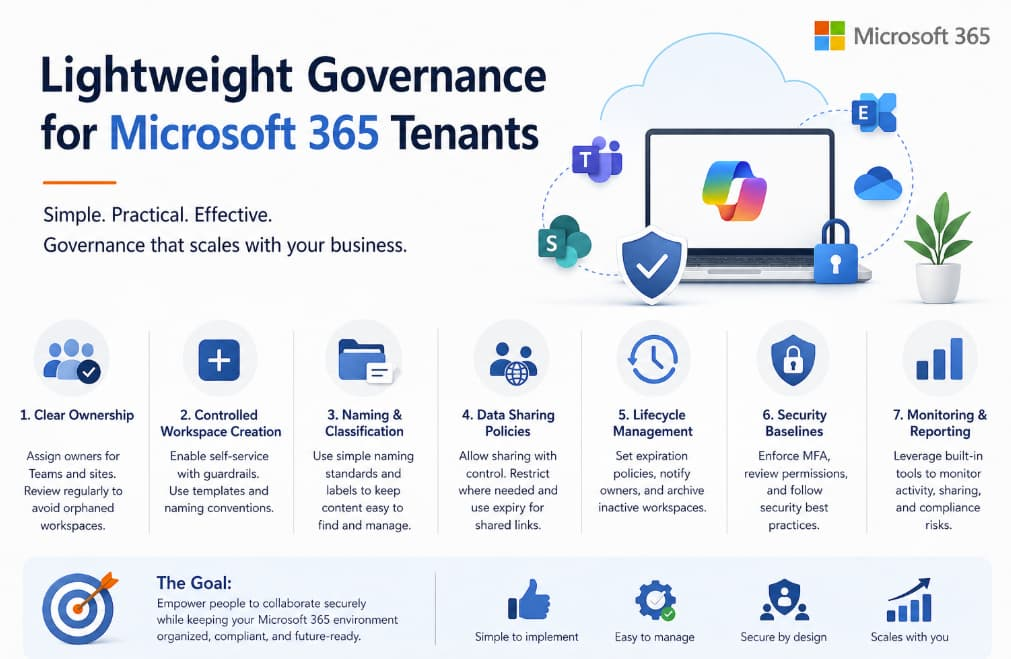
1. Clear Ownership Structure
Every Team, SharePoint site, or group should have a defined owner. This is one of the simplest and most effective governance controls.
Best practices:
- Require at least two owners per Team
- Periodically review inactive or orphaned workspaces
- Assign responsibility for lifecycle management
This ensures accountability without requiring complex approval chains.
2. Controlled Workspace Creation
Unrestricted creation of Teams and Groups can quickly lead to sprawl. However, locking it down entirely can frustrate users.
Lightweight approach:
- Allow self-service creation, but with naming conventions
- Use templates to standardize structure
- Optionally restrict creation to a specific security group if needed
This strikes a balance between freedom and control.
3. Naming Conventions and Classification
A simple naming convention goes a long way in keeping your tenant organized.
Examples:
HR-PoliciesFIN-Budget-2026PRJ-WebsiteRedesign
Pair this with basic classification labels like:
- Public
- Internal
- Confidential
This helps users understand how content should be handled without requiring deep compliance training.
4. Data Sharing Policies
External sharing is one of the biggest risks in M365 environments.
Lightweight controls:
- Enable external sharing but restrict it to specific domains if possible
- Use expiration links for file sharing
- Educate users on when sharing externally is appropriate
Avoid overly restrictive policies that push users toward shadow IT solutions.
5. Lifecycle Management
Not every Team or site should exist forever. Without lifecycle management, clutter builds up quickly.
Simple lifecycle strategy:
- Apply expiration policies (e.g., 180–365 days of inactivity)
- Send renewal notifications to owners
- Archive instead of deleting when unsure
This keeps your environment clean without constant admin intervention.
6. Basic Security Baselines
Security doesn’t need to be complex to be effective.
Minimum recommendations:
- Enable multi-factor authentication (MFA) for all users
- Use conditional access for high-risk scenarios
- Regularly review admin roles and permissions
These measures provide strong protection with minimal ongoing effort.
7. Monitoring and Reporting
You don’t need a full security operations center, but visibility is essential.
Lightweight monitoring:
- Use built-in audit logs
- Review sharing activity periodically
- Track inactive users and unused licenses
This allows you to spot issues early without constant oversight.
Tools That Support Lightweight Governance
Microsoft 365 already includes several built-in tools that make governance easier without additional cost:
- Microsoft Purview for compliance and data classification
- Azure AD (Entra ID) for identity and access management
- SharePoint Admin Center for site controls
- Teams Admin Center for collaboration governance
You don’t need third-party tools unless your requirements become more complex.
Common Mistakes to Avoid
Even with the best intentions, governance efforts can go wrong. Here are some pitfalls to watch out for:
Overengineering the Model
Trying to replicate enterprise governance frameworks often leads to unnecessary complexity.
Ignoring User Experience
If governance makes collaboration harder, users will find workarounds.
Lack of Communication
Policies are only effective if users understand them.
No Ongoing Review
Governance is not “set and forget.” Regular check-ins are essential.
A Practical Example
Consider a 150-user organization adopting M365:
- Users can create Teams freely but must follow naming conventions
- Each Team requires two owners
- External sharing is allowed but monitored
- Teams expire after 12 months of inactivity
- MFA is enforced across the board
This setup takes minimal effort to implement but addresses the majority of common risks.
Lightweight governance is about balance. It recognizes that small-to-mid-sized organizations need structure, but not at the cost of agility. By focusing on simplicity, automation, and user empowerment, you can build a governance model that supports productivity while protecting your environment.
The key is to start small, stay practical, and evolve over time. Governance doesn’t have to be heavy to be effective it just needs to be intentional.
Extra posts:
 From Chaos to Clarity Governance Tips for Organizations Rolling Out Microsoft 365 Copilot
  Architecture Decision Records (ADRs) A Lightweight Governance Model for Modern Software Teams
  Microsoft 365 Purview Your Unified Shield for Data Governance & Compliance
  Governance of AI Agents with Microsoft Entra & Agent 365
  Microsoft Purview HR Connector Streamlining Human Resources Data Governance
  Public vs Private vs Hybrid Cloud Models Explained