
In the world of solution architecture, there is no such thing as a perfect design only well-balanced decisions. Every architectural choice comes with consequences, and understanding those consequences is what separates a good architect from a great one. This is where trade-off analysis becomes a critical skill.
As a solution architect, your role is not just to design systems that work, but to design systems that work well under specific constraints. Whether you’re dealing with scalability, performance, cost, security, or maintainability, improving one dimension often means compromising another. Trade-off analysis is the structured approach to navigating these competing priorities.
What is Trade-Off Analysis?
Trade-off analysis is the process of evaluating multiple architectural options by comparing their strengths and weaknesses across various quality attributes. These attributes might include:
- Performance
- Scalability
- Reliability
- Security
- Cost
- Maintainability
- Time to market
Rather than chasing an ideal solution, architects aim to identify the most appropriate solution for the given business context.
Why Trade-Off Analysis Matters
Modern systems are complex, distributed, and often built on cloud-native technologies. Decisions made early in the design phase can have long-lasting implications. Without a structured way to evaluate trade-offs, teams risk:
- Over-engineering solutions
- Incurring unnecessary costs
- Creating brittle or hard-to-maintain systems
- Missing business objectives
Trade-off analysis ensures decisions are intentional, transparent, and aligned with business goals.
A Real-World Perspective
Consider a scenario where you’re designing a high-traffic e-commerce platform. You need to decide between a monolithic architecture and a microservices architecture.
Monolithic Architecture
Pros:
- Simpler to develop and deploy
- Lower operational overhead
- Easier debugging in early stages
Cons:
- Limited scalability
- Tight coupling
- Slower innovation as system grows
Microservices Architecture
Pros:
- Independent scalability
- Technology flexibility
- Faster team autonomy
Cons:
- Operational complexity
- Higher infrastructure cost
- Distributed system challenges (latency, consistency)
There is no universally correct answer. If your business is a startup aiming for rapid MVP delivery, a monolith may be the better choice. If you’re scaling globally with multiple teams, microservices might be worth the complexity.
The decision depends on context, not trends.
Key Dimensions in Trade-Off Analysis
1. Performance vs Cost
High performance often requires more resources compute, memory, caching layers which directly increases cost. For example:
- Using in-memory databases improves latency but raises infrastructure expenses.
The question becomes: Is the performance gain worth the cost?
2. Scalability vs Complexity
Highly scalable systems (e.g., microservices, event-driven architectures) introduce complexity:
- More services to manage
- Network communication overhead
- Increased failure points
You must assess whether the expected growth justifies this complexity.
3. Consistency vs Availability
In distributed systems, this is a classic dilemma. Strong consistency can reduce availability during failures, while eventual consistency improves availability but may introduce temporary data discrepancies.
Understanding business tolerance is key:
- Banking systems require strong consistency
- Social media feeds can tolerate eventual consistency
4. Time to Market vs Technical Excellence
Sometimes, delivering quickly is more valuable than delivering perfectly. Startups often prioritize speed over ideal architecture.
However, shortcuts today can become technical debt tomorrow. A good architect plans for evolution, not perfection.
5. Security vs Usability
Stronger security measures (multi-factor authentication, strict access controls) can impact user experience. The balance depends on:
- Regulatory requirements
- Sensitivity of data
- User expectations
Techniques for Effective Trade-Off Analysis
1. Define Quality Attributes Clearly
Avoid vague terms like “fast” or “scalable.” Instead, define measurable criteria:
- Response time < 200ms
- System supports 10,000 concurrent users
This makes comparisons objective.
2. Use Scenario-Based Evaluation
Frame decisions using real scenarios:
- What happens under peak load?
- How does the system behave during failure?
This approach surfaces hidden trade-offs.
3. Leverage Architectural Decision Records (ADRs)
Document decisions along with:
- Alternatives considered
- Trade-offs evaluated
- Rationale behind the choice
This improves transparency and future maintainability.
4. Apply the “Fitness Function” Approach
Continuously validate whether the system meets desired attributes using automated tests or monitoring.
5. Collaborate with Stakeholders
Trade-offs are not purely technical decisions. Involve:
- Business leaders (cost, time)
- Product managers (user experience)
- Security teams (risk tolerance)
Architecture is a team sport.
Common Pitfalls to Avoid
Chasing Trends
Just because something is popular (e.g., microservices, serverless) doesn’t mean it’s right for your use case.
Ignoring Long-Term Impact
Short-term decisions can lead to long-term pain if scalability or maintainability is overlooked.
Lack of Documentation
Undocumented decisions create confusion and slow down future development.
Over-Optimization
Trying to optimize for every dimension often leads to unnecessary complexity. Focus on what truly matters.
A Practical Framework
A simple way to approach trade-off analysis:
- Identify Requirements
- Functional and non-functional
- List Alternatives
- Different architectural styles or technologies
- Define Evaluation Criteria
- Based on business priorities
- Score Each Option
- Qualitative or quantitative
- Discuss and Decide
- Involve stakeholders
- Document the Decision
- Capture reasoning for future reference
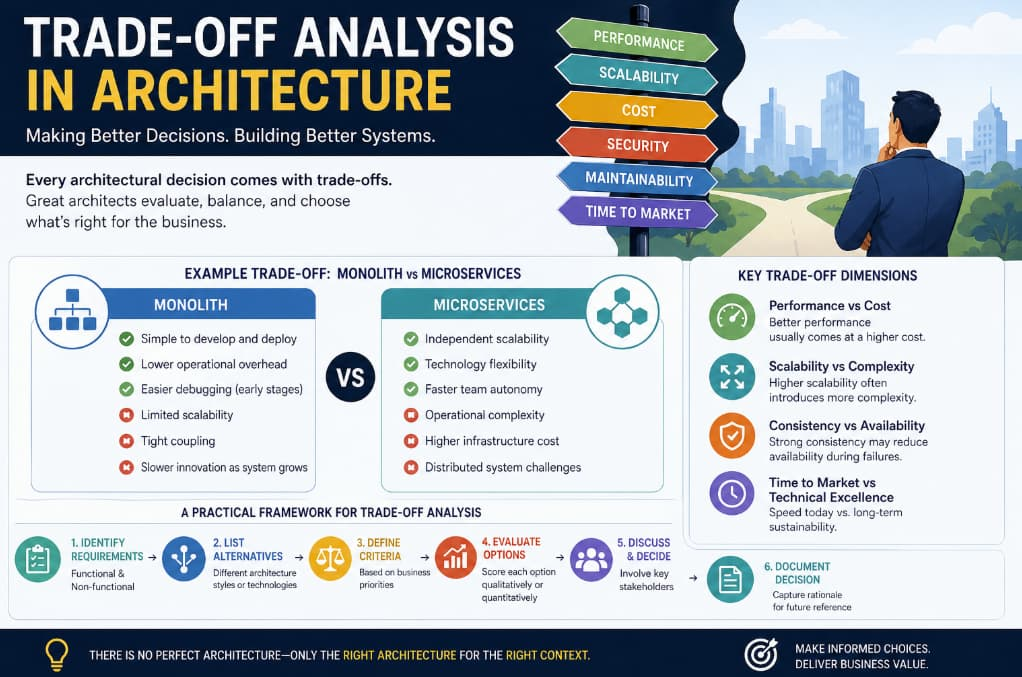
Trade-off analysis is not about finding the best solution—it’s about finding the right solution under given constraints. As a solution architect, your value lies in making informed, balanced decisions that align technology with business outcomes.
The most effective architects are not those who avoid trade-offs, but those who understand, communicate, and manage them effectively.
In a rapidly evolving technology landscape, mastering trade-off analysis is not optional—it’s essential.