
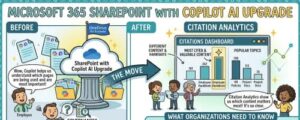
Microsoft is giving SharePoint site owners a new way to understand how their content is being used by artificial intelligence. Starting in August 2026, organizations with more than 50 Microsoft 365 Copilot licenses will begin receiving new Copilot citation analytics that show how often SharePoint documents, pages, and news posts are referenced in Microsoft 365 Copilot chat responses.
The update may look like a relatively small analytics improvement, but it could become an important tool for organizations trying to understand the value of their internal content in an increasingly AI-driven workplace.
Microsoft says the new capability is designed to help SharePoint site owners and content authors identify content that is frequently referenced by Copilot. Instead of relying only on traditional measures such as page views, document views, or the number of visitors, organizations will have another metric to consider: how often their content is cited by AI.
The feature is associated with Microsoft 365 Roadmap ID 480725 and is scheduled for worldwide general availability during August 2026.
SharePoint is getting an AI-focused analytics layer
For years, SharePoint analytics have largely focused on conventional measures of content engagement. Site owners could see which pages were popular, how many people viewed documents, and which content attracted the most visitors.
Microsoft’s new update adds another dimension.
With Copilot citation analytics, organizations can see when their SharePoint content becomes a source for answers generated through Microsoft 365 Copilot chat. That could provide a very different perspective on which information employees actually depend on.
A document might receive relatively few direct page views but still be highly valuable because employees regularly access its information indirectly through Copilot. Similarly, an internal policy page may not appear among the most visited pages on a SharePoint site, yet it could be frequently cited when employees ask Copilot questions about company procedures.
That distinction could become increasingly important as AI assistants become part of everyday workplace searches and workflows.
What will change in SharePoint?
According to Microsoft’s update, several areas of SharePoint will receive new AI citation information.
One of the biggest changes will appear in Site Usage. The existing Popular content section will be able to rank documents, news posts, and pages according to how frequently they are cited by Copilot chat.
This gives content owners another way to identify high-impact information.
SharePoint page analytics will also receive a new Total citations card. For individual pages and news posts, the metric will show how many times the content has been referenced in Microsoft 365 Copilot chat responses.
File statistics will receive a similar addition. A new AI citations metric will appear alongside existing measurements such as views and viewers.
Microsoft is also introducing a dedicated Copilot citations analytics page within Site Usage.
The new analytics page is expected to provide several useful measurements, including the number of users who consume site content through Copilot citations, the total number of citations generated for a site, and the documents, news posts, and pages that are cited most frequently.
For content managers, this could make it easier to identify information that has become particularly important to employees using AI.
Why AI citations could matter to content teams
The importance of this update goes beyond simply adding another number to SharePoint analytics.
Many organizations are currently reassessing how they create, organize, maintain, and retire internal content because employees are increasingly using AI tools to find information.
Traditional content analytics can tell administrators what people are clicking on. AI citation analytics can provide clues about what information is being used to answer employee questions.
That could influence content strategy.
For example, imagine a company has hundreds of SharePoint documents covering its human resources policies. Some documents might receive thousands of traditional views, while others receive relatively little traffic. After employees begin using Microsoft 365 Copilot, however, a different pattern could emerge.
A less frequently viewed document might become one of the organization’s most frequently cited sources in Copilot conversations.
That information could tell content teams that the document contains valuable information even though its conventional traffic numbers are modest.
On the other hand, content that receives little traffic and is rarely cited by Copilot could become a candidate for review, consolidation, or eventual retirement.
In that sense, AI citations could become another signal for content governance and lifecycle management.
More visibility into the role of SharePoint content
One of the broader questions surrounding workplace AI has been relatively simple: What information is actually helping the AI answer employees’ questions?
The new SharePoint analytics could provide organizations with part of that answer.
By identifying frequently cited documents, pages, and news posts, site owners can potentially understand which pieces of corporate knowledge are being surfaced through Copilot.
This could also help content authors prioritize updates.
If a particular policy document is frequently cited, keeping that document accurate and up to date becomes especially important. An outdated document that is heavily relied upon by AI could potentially have a much greater impact than an outdated page that nobody reads.
Organizations may therefore want to pay closer attention to their highest-cited content.
The data could also help identify opportunities to improve content structure, naming conventions, document organization, and information architecture.
There is an important limitation
While the new analytics sound broad, Microsoft has specified that citation tracking in this release covers only certain Copilot experiences.
The citations counted by the new metrics come from Microsoft 365 Copilot chat on desktop and the web. Microsoft specifically identifies Microsoft 365 Copilot chat at m365.cloud.microsoft/chat and the Microsoft 365 Copilot desktop app as part of the supported scope.
Other Copilot experiences are not included in the initial release.
That means organizations should not interpret the new citation numbers as a complete measurement of every time their SharePoint content is used by Microsoft AI.
The current scope excludes experiences such as Copilot in Word, Excel, and PowerPoint, as well as Cowork, Copilot in SharePoint, SharePoint custom agents, Copilot Studio agents accessed outside Copilot, custom engine agents, and agents using a custom orchestrator.
Microsoft notes that this scope could expand in future releases.
That distinction will be important for organizations comparing AI citation numbers with broader AI usage.
Who will receive the feature?
The update is aimed at SharePoint Online site owners, content authors, and administrators in organizations that have more than 50 Microsoft 365 Copilot licenses or seats.
This licensing threshold is one of the most important details for organizations planning around the rollout.
Having Microsoft 365 Copilot in an organization is not, by itself, enough according to Microsoft’s announcement. The new insights are intended for tenants with more than 50 Copilot licenses.
The rollout is scheduled to begin at the start of August 2026 and is expected to be completed by the end of August 2026 worldwide.
Microsoft previously listed the rollout for July but subsequently updated the timing to August.
No administrator action required
There is also relatively little preparation required from IT administrators.
Microsoft says the feature will be enabled by default, meaning organizations do not need to switch it on manually when the rollout reaches their tenant.
There is also no specific administrative action required before the rollout.
However, Microsoft recommends that organizations consider informing SharePoint site owners and content authors about the new analytics.
Companies may also want to review their existing SharePoint reporting processes and determine how AI citation data could fit into content governance, content strategy, and lifecycle planning.
Organizations that centrally manage Microsoft 365 Copilot licenses may also want to make sure employees understand the licensing requirements associated with the feature.
What this means for SharePoint users
For everyday SharePoint users, the change may not dramatically alter the way they create or consume content.
For content owners and administrators, however, it could provide a valuable new source of information.
The traditional question has been: How many people viewed this content?
With the new analytics, organizations can start asking another question: How often did AI rely on this content to answer employees’ questions?
That shift reflects the changing nature of workplace information.
As employees increasingly turn to AI instead of navigating through folders, pages, and document libraries themselves, content can become valuable without generating conventional page traffic. AI may effectively become a new route through which employees discover and consume organizational knowledge.
SharePoint’s new citation analytics are designed to make that hidden layer of engagement more visible.
A new metric for the AI workplace
The August 2026 rollout is ultimately another sign that enterprise content analytics are evolving alongside workplace AI.
Views and visitors will continue to matter, but they may no longer tell the entire story. As AI assistants increasingly act as an interface to corporate knowledge, organizations need ways to understand which sources are being surfaced and relied upon.
Microsoft’s Copilot citation analytics offer one answer.
For SharePoint owners, the new metrics could help identify high-value content, improve governance, prioritize updates, and better understand how employees are accessing company knowledge through AI.
The feature is not a complete picture of AI content usage, given its initial limitation to Microsoft 365 Copilot chat on the web and desktop. But it represents an important step toward measuring a new kind of engagement—content consumption through AI-generated answers rather than direct clicks.
As the rollout continues through August, organizations with more than 50 Microsoft 365 Copilot licenses will be able to see whether their SharePoint content is merely being stored and viewed, or whether it has become part of the information employees are turning to through AI.
For companies investing heavily in both SharePoint and Microsoft 365 Copilot, that distinction could become increasingly important.
Extra posts:
 The “Agentic” Intranet: Securing and Scaling M365 Copilot with SharePoint & Teams
  How to Configure DLP Policies for Copilot-Generated Content: A Practical Guide for Secure AI Adoption
  Unlocking the Power of SharePoint Embedded A Modern Approach to Content Management
  Employee Onboarding in a Day: Creating Role-Specific Training Guides from SharePoint Content
  Pre-Flight Check The 5 Non-Negotiable SharePoint Cleanups Before Deploying Copilot
  Upgrade Available appears on servers and databases for new SharePoint 2016 Farm