

Researching a business topic often takes more time than expected. You might start by reviewing industry reports, searching competitor websites, checking internal documents, and collecting market data. Before long, you have dozens of browser tabs, scattered notes, and no clear picture of what the findings actually mean for your business.
Microsoft Copilot Cowork offers another approach. Instead of asking an AI assistant a series of disconnected questions, you can delegate a multi-step research task, provide context, and ask it to organize the findings into a practical deliverable. Depending on your available features and permissions, Cowork can also work with organizational information, create documents, and help turn research into material that stakeholders can use.
For solution architects, IT professionals, business analysts, and software developers, this creates an opportunity to spend less time collecting information and more time evaluating options, identifying risks, and making informed decisions.
The key is knowing how to define the research task, guide Cowork through the process, and validate the results before relying on them.
What Is Copilot Cowork, and Why Use It for Business Research?
Microsoft 365 Copilot Cowork is designed to handle multi-step work across supported Microsoft 365 applications and connected resources. You describe the outcome you want, and Cowork plans and carries out the work, with opportunities to review its progress and approve important actions.
For business research, that means you can move beyond simple prompts such as “What is cloud computing?” and request a structured investigation into a specific business problem.
For example, imagine your organization is evaluating whether to modernize its legacy applications using cloud-native architecture. Rather than manually gathering information from scratch, you could ask Cowork to investigate the business drivers, compare architectural approaches, identify security and migration risks, and prepare a report for an architecture review meeting.
Depending on the enabled research capabilities and available sources, Cowork can help with:
- Research and synthesis: Investigate a topic across multiple sources and organize the findings into a coherent analysis.
- Internal knowledge discovery: Search accessible organizational resources, including relevant files and information in Microsoft 365.
- Document creation: Prepare structured reports and supporting Word, Excel, PowerPoint, or PDF deliverables.
- Research coordination: Break a broad request into smaller tasks, review progress, and refine the output as new questions emerge.
These capabilities make Cowork useful for market research, technology assessments, competitor analysis, business case development, and strategic planning.
The important distinction is that Cowork helps execute a research workflow. It does not remove the need for professional judgment or independent verification.
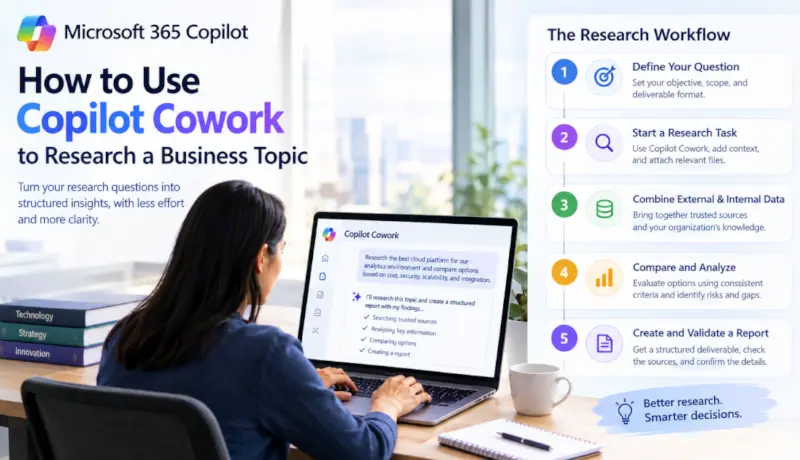
Step 1: Define a Business Research Question
The quality of your research depends heavily on how clearly you define the problem.
A broad request such as “Research artificial intelligence in business” leaves too much room for interpretation. You might receive a general overview when what you really need is an evaluation of implementation costs, governance requirements, and potential return on investment.
Start by identifying three things:
- Business objective: What decision will the research support?
- Research scope: Which technologies, markets, competitors, or business processes should be included?
- Expected deliverable: Do you need an executive briefing, a technical comparison, a market analysis, or a detailed report?
For example, a solution architect could use the following prompt:
Research whether a mid-sized enterprise should adopt a cloud-based data platform to replace its legacy analytics environment. Compare the business benefits, implementation costs, scalability, security considerations, integration challenges, and operational risks. Identify the assumptions behind your findings, highlight areas requiring further investigation, and prepare a structured report for IT leadership. Distinguish verified facts from estimates and recommendations.
This prompt establishes a decision, defines the evaluation criteria, and explains who will use the results.
It also gives Cowork a clear target instead of expecting it to infer your requirements from a vague topic.
Step 2: Start a Research Task in Copilot Cowork
Once you have defined the objective, open Microsoft Copilot and select the Cowork experience. In supported environments, Cowork is available through the Microsoft 365 Copilot web experience and desktop application. Availability and setup requirements depend on your account type, license, and organizational configuration.
Enter your research request in the prompt field. Include the intended audience, relevant business context, scope, and preferred output format.
If you already have supporting material, attach relevant files where permitted. These might include:
- Existing architecture diagrams and technical assessments.
- Internal strategy documents or business requirements.
- Vendor proposals and product comparison spreadsheets.
- Previous market research reports.
- Project budgets, migration plans, or risk registers.
For instance, if you are researching enterprise integration platforms, supplying your current application inventory and integration requirements can make the resulting analysis more relevant than a generic comparison of products.
Keep the scope focused enough to evaluate. A single request covering every cloud provider, integration pattern, licensing model, and security framework can produce an unwieldy report. Break particularly large investigations into separate workstreams, such as technical feasibility, financial impact, security, and vendor evaluation.
As Cowork works, review its progress and provide clarification when necessary. You can pause, redirect, or cancel a task when the research is moving away from the intended objective.
Step 3: Combine External Research With Internal Business Context
A useful business recommendation needs more than publicly available information. It also needs to reflect the organization’s actual constraints.
Consider a company researching a migration from on-premises infrastructure to a cloud platform. Public sources can help explain service capabilities, industry trends, pricing models, and documented product limitations. Internal documents can reveal existing dependencies, compliance requirements, staffing constraints, and operational priorities.
When the relevant integrations and permissions are available, Cowork can help bring these two perspectives together.
Ask it to organize the investigation into distinct categories:
- Market and industry: Current trends, adoption patterns, and relevant industry developments.
- Technical capabilities: Architecture, interoperability, scalability, performance, and integration.
- Financial considerations: Licensing, infrastructure costs, implementation effort, and ongoing operations.
- Security and compliance: Identity management, access controls, data residency, audit requirements, and regulatory obligations.
- Organizational fit: Existing skills, legacy dependencies, business priorities, and implementation readiness.
Be explicit about what should count as evidence. Ask for authoritative documentation, publication dates, source links, and clear distinctions between established facts and interpretation.
For technology research, vendor documentation and standards publications are generally more appropriate for validating technical claims than marketing summaries alone. Independent reports and credible industry analysis can add context, but their assumptions and publication dates still matter.
One important limitation: access to internal information does not automatically guarantee comprehensive external research, and not every source or connector will be available in every Cowork environment. Confirm which information the task actually used.
Step 4: Turn the Findings Into a Structured Analysis
Collecting information is only half the job. The real value comes from comparing the evidence and understanding its implications.
Once Cowork has assembled the initial findings, ask it to evaluate the alternatives against consistent criteria.
For a cloud platform assessment, a comparison matrix might look like this:
| Evaluation criterion | Questions to answer |
|---|---|
| Cost | What are the initial and recurring expenses? |
| Scalability | Can the platform handle projected growth? |
| Security | Does it meet the organization’s security requirements? |
| Integration | How difficult is it to connect existing applications? |
| Operations | What skills and maintenance effort will be required? |
| Vendor dependency | How difficult would it be to migrate away later? |
Ask Cowork to identify trade-offs rather than simply ranking options. A platform with a lower entry cost might require more engineering effort, while a managed service might reduce operational overhead but introduce vendor lock-in.
A useful follow-up prompt is:
Compare the shortlisted options using the evaluation criteria provided. Explain the evidence supporting each assessment, identify missing information, and distinguish measurable differences from subjective judgments. Include a risk register and recommend the next steps needed to validate the preferred option.
This approach makes the research more useful to decision-makers because it connects technical findings to business consequences.
It also exposes uncertainty. If there is insufficient information to compare two vendors’ long-term operating costs, the report should say so instead of presenting an unsupported conclusion.
Step 5: Create a Report and Validate the Results
After reviewing the analysis, ask Cowork to produce the deliverable that best fits your audience.
An executive report might include the business problem, key findings, financial implications, major risks, and recommended next steps. A technical report may need architecture considerations, integration dependencies, security controls, and a phased implementation plan.
For example, you could request:
Create a concise business research report for IT leadership. Include an executive summary, research methodology, comparison matrix, evidence and source links, key risks, unresolved questions, and prioritized recommendations. Use clear headings and separate confirmed findings from assumptions. Include an appendix for technical details.
Cowork can help create and edit supported document formats, including Word documents, spreadsheets, presentations, and PDFs. Review the output to confirm that it meets your organization’s reporting standards.
Before sharing the report, perform a final quality check:
- Verify factual claims. Open the cited sources and confirm that they support the statements being made.
- Check recency. Technology features, product licensing, prices, and regulatory requirements can change quickly.
- Inspect calculations. Independently validate cost estimates, financial projections, and scoring models.
- Review assumptions. Ensure that the analysis reflects your organization’s actual requirements.
- Identify gaps. Record unanswered questions and evidence that needs to be collected.
- Check confidentiality. Confirm that the document contains no sensitive information that should not be shared with its intended audience.
Treat AI-generated recommendations as decision support, not as automatic approval for architectural, financial, or security decisions.
Practical Tips for Better Copilot Cowork Research
A few adjustments can significantly improve the quality of your results.
Use measurable research criteria. Instead of asking which solution is best, specify the criteria that matter, such as five-year total cost of ownership, recovery objectives, integration complexity, or regulatory coverage.
Ask for evidence alongside conclusions. Request links, publication dates, supporting excerpts where appropriate, and explanations of how each source informs a recommendation.
Separate discovery from evaluation. First gather the relevant information. Then compare the alternatives. Finally, develop recommendations. This makes it easier to identify gaps before they affect the final decision.
Challenge the initial recommendation. Ask Cowork to identify counterarguments, hidden costs, implementation risks, and scenarios in which the preferred option would not be suitable.
Keep a human reviewer involved. A technical lead, business analyst, security specialist, or financial stakeholder should validate findings relevant to their area of responsibility.
Make Business Research More Actionable With Copilot Cowork
Copilot Cowork can help transform business research from a fragmented collection of searches and notes into a more organized workflow. By defining a clear objective, providing relevant context, comparing alternatives against consistent criteria, and requesting a structured deliverable, you can produce research that better supports real business decisions.
The most effective approach is to start with a focused question and a specific outcome. For your next technology assessment or market investigation, choose one business problem, identify the evidence you need, and ask Cowork to produce an initial analysis. Review the sources, challenge the assumptions, and refine the recommendations before sharing the report.
That final review is what turns a convenient AI-generated summary into research your team can use with confidence.
Extra posts:
 15 Microsoft 365 Copilot Cowork Use Cases for Business Leaders
  How to Use Copilot Cowork to Create an Executive Report
  How to Use Microsoft 365 Copilot Cowork to Clean Up Your Inbox
  How to Use Copilot Cowork to Find Information Across SharePoint and OneDrive
  What Do You Use Copilot Cowork For? Practical Ways to Get More Done
  Microsoft Gives Admins More Control Over Copilot Cowork Browser Access