

Architecting software systems is as much about managing complexity as it is about writing code. Over the years, many architectural styles have emerged to help teams build systems that are scalable, maintainable, and adaptable to change. Among the most widely discussed are Layered Architecture and Clean Architecture.
While both approaches aim to structure systems in a logical and manageable way, they differ significantly in philosophy, dependency management, and long-term flexibility. In this article, I’ll walk through both architectures from a solution architect’s perspective, compare them, and highlight when each approach makes sense in real-world systems.
Understanding Layered Architecture
Layered Architecture (often called the “n-tier architecture”) is one of the most traditional and widely adopted architectural styles. It organizes a system into horizontal layers, where each layer has a specific responsibility and communicates primarily with the layer directly above or below it.
Typical Layers
A common implementation includes:
- Presentation Layer: Handles user interaction (UI, APIs, controllers)
- Business Logic Layer (Service Layer): Contains core application logic
- Data Access Layer (DAL): Responsible for database interactions
- Database Layer: Stores persistent data
Key Characteristics
- Separation of concerns: Each layer has a distinct responsibility.
- Top-down flow: Requests typically flow from presentation → business → data.
- Tight coupling between adjacent layers: Each layer depends on the one below it.
- Easier to understand: Straightforward mental model, especially for new developers.
Strengths
- Simple to implement and understand
- Works well for small to medium-sized applications
- Aligns naturally with many frameworks (e.g., MVC-based frameworks)
- Clear separation of responsibilities
Limitations
- Rigid structure: Changes in lower layers can ripple upward
- Tight coupling between layers can make refactoring difficult
- Business logic often becomes dependent on infrastructure concerns
- Harder to test in isolation due to dependencies on concrete implementations
In practice, layered architecture is often sufficient for CRUD-heavy applications or systems with relatively stable requirements.
Understanding Clean Architecture
Clean Architecture, popularized by Robert C. Martin (Uncle Bob), takes a more domain-centric approach. It emphasizes independence of frameworks, UI, databases, and external agencies.
Instead of organizing code by technical layers, Clean Architecture organizes it by dependency rules and business rules at the center.
Core Principle: Dependency Rule
Source code dependencies must point inward toward the business logic.
This means:
- Inner layers know nothing about outer layers
- Outer layers depend on inner layers, not the other way around
Typical Structure
Clean Architecture is often visualized as concentric circles:
- Entities (Domain Layer)
- Core business objects and rules
- Independent of frameworks or external systems
- Use Cases (Application Layer)
- Application-specific business logic
- Orchestrates entities to perform operations
- Interface Adapters
- Converts data between external systems and use cases
- Includes controllers, presenters, gateways
- Frameworks & Drivers
- UI frameworks, databases, external APIs
- The outermost layer
Key Characteristics
- Framework independence
- Testability without infrastructure
- Strict dependency inversion
- Highly decoupled design
Strengths
- Business logic is isolated and protected
- Easier to test core logic without external dependencies
- Flexible and adaptable to change (e.g., swapping databases or UI frameworks)
- Encourages long-term maintainability
Limitations
- More complex to set up initially
- Requires discipline and architectural understanding
- Can feel over-engineered for small applications
- More boilerplate code due to abstraction layers
Layered vs. Clean Architecture: Key Differences
Let’s break down the differences across several dimensions.
1. Dependency Direction
- Layered Architecture: Dependencies flow downward between layers.
- Clean Architecture: Dependencies always point inward toward the domain.
This is perhaps the most fundamental distinction. Clean Architecture enforces strict inversion of control using abstractions, ensuring the business logic remains independent.
2. Coupling
- Layered Architecture: Tighter coupling between layers, especially adjacent ones.
- Clean Architecture: Loose coupling through interfaces and dependency inversion.
In Clean Architecture, outer layers implement interfaces defined by inner layers, reducing dependency on concrete implementations.
3. Testability
- Layered Architecture: Testing can be challenging due to dependencies on databases or frameworks.
- Clean Architecture: Highly testable because core business logic can be tested in isolation using mocks or stubs.
4. Flexibility and Maintainability
- Layered Architecture: Less flexible when adapting to major changes in infrastructure.
- Clean Architecture: Highly adaptable—swapping a database or UI framework has minimal impact on core logic.
5. Complexity
- Layered Architecture: Simpler and easier to implement.
- Clean Architecture: More complex, requires understanding of abstraction, dependency inversion, and interface design.
6. Code Organization
- Layered Architecture: Organized by technical concerns (controllers, services, repositories).
- Clean Architecture: Organized around business use cases and domain entities.
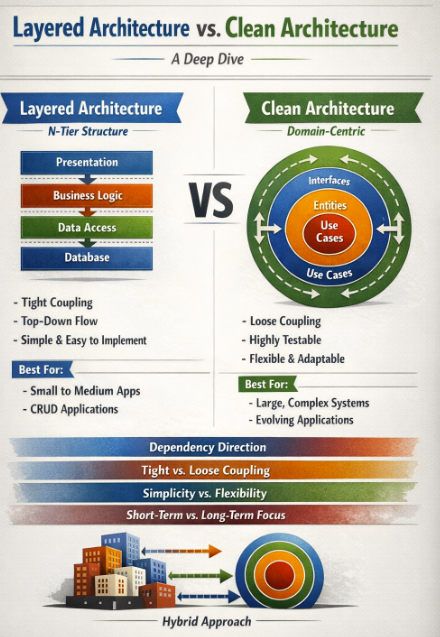
When to Use Layered Architecture
From a solution architect’s standpoint, layered architecture is a practical choice in the following scenarios:
- Small to medium-sized applications
- Projects with tight deadlines
- Teams with limited architectural experience
- CRUD-heavy systems with minimal complex business logic
- Applications unlikely to undergo frequent major changes
It provides a good balance between structure and simplicity, making it a solid default choice for many teams.
When to Use Clean Architecture
Clean Architecture shines in systems where long-term maintainability and flexibility are critical:
- Large-scale enterprise applications
- Systems with complex business rules
- Applications expected to evolve over time
- Projects requiring high test coverage
- Systems integrating multiple external services or interfaces
As a solution architect, I often recommend Clean Architecture when:
- The domain is complex and central to the business value
- The system needs to survive multiple technology changes
- Multiple teams are working on different parts of the system
- You want to enforce strict separation of concerns
Real-World Perspective
In practice, architecture decisions are rarely black and white. Many systems end up using a hybrid approach:
- A layered structure for outer concerns (controllers, APIs)
- Clean Architecture principles for core domain logic
- Selective use of dependency inversion where it matters most
This pragmatic blending allows teams to avoid over-engineering while still protecting critical business logic.
Common Pitfalls
Overengineering with Clean Architecture
Not every system needs strict adherence to Clean Architecture. Applying it blindly can lead to unnecessary abstraction layers and increased complexity without tangible benefits.
Misusing Layered Architecture
A common issue is letting business logic leak into controllers or repositories, resulting in “fat controllers” or “anemic domain models.”
Ignoring Dependency Inversion
Regardless of the architecture chosen, failing to invert dependencies properly leads to tightly coupled systems that are hard to maintain.
Both Layered Architecture and Clean Architecture serve the same ultimate goal: managing complexity in software systems. The difference lies in how they approach separation of concerns, dependency management, and adaptability.
- Layered Architecture is straightforward, pragmatic, and ideal for simpler systems or teams that value speed and clarity.
- Clean Architecture is more structured, principle-driven, and suited for complex, evolving systems where long-term maintainability is a priority.
As a solution architect, the decision is less about choosing the “best” architecture and more about choosing the right architecture for the context. Understanding both approaches allows you to tailor your design to meet business goals while balancing complexity, cost, and scalability.
Ultimately, architecture is not just about organizing code—it’s about enabling teams to deliver value efficiently over time.
Extra posts:
 Deep Dive into Microsoft Lists Advanced Formatting and Automation
  Unlocking Productivity A Deep Dive into Notepad and Copilot in Windows 11
  Agentic AI in Microsoft Teams: The Future of Workplace Automation (Technical Deep Dive)
  Deep Dive: Implementing Retrieval-Augmented Generation (RAG) with Azure AI Search
  Navigating Compliance with Confidence A Deep Dive into Microsoft Purview Compliance Portal
  How Microsoft Keeps Your Data Safe in the Cloud – A Deep Dive into Cloud Security Practices